A page painted in 1552 carries 4 plants in a row and their names written in red above them. In the middle, tlilxochitl, the black flower. This is the oldest written trace of vanilla. The hand that sets it down is Nahua. The century that follows sees that name cross the Atlantic, pass into Latin, into Castilian, into English. It comes apart a little at each stage, while the pod itself arrives intact.
A page painted in 1552
At the college of Santa Cruz de Tlatelolco, opened to teach the sons of the Nahua nobility, a physician from Xochimilco named Martín de la Cruz composes a herbal in his own language in 1552. Juan Badiano, also from Xochimilco, translates it into Latin. The work leaves for Spain as a gift to the King. 249 plants appear in it, 184 are painted. It bears the title Libellus de medicinalibus Indorum herbis1. It is the oldest treatise of medicine in the Americas. The chain that writes it is indigenous from end to end.
Folio 56 verso carries 4 plants in a row, each one topped by its name in red. Mecaxochitl. Tlilxochitl. Hueynacaztli. Copalxocotl. The roots are drawn as dark clods after the convention of the Aztec painters, the stems carry small flowers, bluish on the middle one.
Below the plants, 2 words in red give the title of the recipe. Viatoris presidium, the traveller's safeguard.
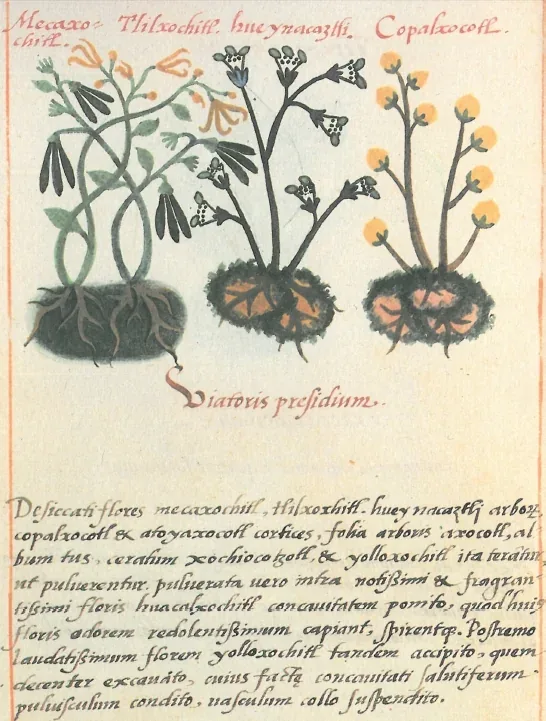
The Latin that follows dictates the gesture. Dry the flowers of mecaxochitl, of tlilxochitl and of hueynacaztli, add to them the barks of copalxocotl and of atoyaxocotl, the leaves of the axocotl tree, white incense, the resins of xochiocotzotl and of yolloxochitl. Reduce all of it to powder. Place that powder in the hollow of a huacalxochitl flower, the most fragrant of all, so as to breathe its scent. Then hollow out a yolloxochitl flower neatly, lay the health-giving powder inside it, then hang that little vessel from the neck.
Here then is vanilla in the first document that names it. A scent worn on the body, against the perils of the road. It enters the written record through smell, 3 centuries before it enters an ice cream.
The painting, for its part, calls for caution. The line follows the Aztec conventions, clod of roots and compact habit, it shows a herb where a vine grows to the height of a tree. Luis Gómez reads it as the first depiction of a Mesoamerican orchid, 2 centuries before the genus Vanilla was published2. The name written above it, for its part, reads clean.
One last detail is visible to the naked eye on the plate. Badiano writes presidium where classical Latin calls for praesidium. The pupil of Tlatelolco held his learned language from recent study. The manuscript keeps the trace of that apprenticeship.
Black flower, hidden flower, fragrant vine
Tlilli means black, xochitl means flower. Tlilxochitl describes a cured pod, dark and glossy. That is the name Nahuatl gives, the language of the high country, the language of those who receive the pod at the end of a long carry.
On the coast of the gulf, the Totonac hold an ancient relation with the plant. They call it xanat. The Totonac dictionary of the Academia Veracruzana de las Lenguas Indígenas gives that entry 2 senses held together, the flower above all others and vanilla13. The same word therefore names the flower and the pod. A study published in 2019 records the form Axi-Xanath, which Spanish renders as flor recóndita, the hidden flower8. On the beginnings of cultivation, Lubinsky and co-authors write in 2008 that the circumstances remain incompletely known. The Totonac of Papantla are presumed to have been among the first to cultivate the vine, while the oldest reports of use point to the pre-Columbian Maya11.
Further south, the Maya of Yucatán and Petén name it sisbic, or sisbic-ak, the fragrant vine. A recent survey of 85 traditional midwives across 47 localities of Quintana Roo and Yucatán still records 11 living names for this plant, with 4 uses held together, medicine, ritual, perfume and flavour8.
3 languages, 3 ways of looking. Nahuatl keeps the colour of a pod laid out on a market stall. Totonac keeps a flower one has to look for in the forest. Maya keeps the vine that climbs and the scent it gives. The last 2 are born where the vine grows. The first comes from the high country, where the pod arrives by way of the market. That is the one that will cross the ocean.
Below 1552, the written record stops. The writing systems of Mesoamerica hold their silence on this plant. Archaeology has so far yielded all its residues elsewhere. What comes before rests in the memory of languages and in the stories handed down at Papantla, where the vine is born from the blood of a princess. The plant itself had been growing there all along, in the same humid forests that the wild vanillas occupy on the other side of the world.
What Sahagún puts in the cacao
25 years later, the same college produces the other great book. Between 1545 and 1577, Nahua scholars gather the words of elders on questionnaires set by the Franciscan Bernardino de Sahagún. The answers come first as paintings, after the custom of the country, then pass into alphabetic writing under the hand of students of the college. Sahagún sets a Spanish column facing them.
12 books come out of it, 2,500 images painted by hand. The manuscript finished in 1577 leaves for Europe and enters the Medici library in Florence, from which it takes the name it is read under today. The source closest to the plant is itself a source that crossed the ocean.
The book of illnesses places tlilxochitl in a remedy, with its companions of 1552.
Los que escupen sangre se curarán bebiendo el cacao con aquellas especies aromáticas, que se llaman tlilxochitl, mecaxochitl, y veynacaztli, y con cierto género de chille llamado chiltecpin muy tostado.
The triad comes back intact. The tlilxochitl, the mecaxochitl and the hueinacaztli, which the Spanish will call the little ear for the shape of its flower. This time they go into cacao, with a chilli roasted hard, for those who spit blood.
That pairing holds. It will be found again in a Latin treatise printed at Rome, then in a recipe printed at Madrid, 79 years after the painted page of Tlatelolco.
The King's physician measures it
In 1570, Philip II sends his chief physician, Francisco Hernández, to Mexico with a survey to carry out. The King wants the inventory of the medicinal plants of his possessions, their name, their use, their virtue. 7 years on the ground, plant gathering, interviews with healers, Nahua painters who carry the plants onto paper. More than 3,000 species enter his volumes.
His way of naming deserves a look. Each entry opens on the Nahuatl word, the Latin translation comes after. Indigenous knowledge keeps first place right down to the typography.
Chapter XV of book III belongs to vanilla.
De TLILXOCHITL seu flore nigro, Araco Aromatico.
The Nahuatl name first, the gloss “black flower” next, the Latin name last. Aracus in the ancient authors means a climbing legume. The vine climbs, the pod hangs, the vocabulary at hand turns it into a bean. The orchid will wait for the 18th century. The Planifolia will receive its species name in 1808.
The description, for its part, still stands today. A twining herb, leaves like plantain but thicker and longer, alternate on either side of the stem, pods long, narrow, almost cylindrical, smelling of musk or of balsam, black, whence the name. It grows in hot and humid country. It embraces the trees. It gives its pods in spring.
Then the triad returns, in Latin this time. These pods are hot in the third degree. Custom has them added to cacaoatl and to mecaxochitl. The medicine of the day ranks every substance on a scale of hot and cold, dry and moist, in 4 degrees. Vanilla comes out high on that scale, which fits it to cold stomachs and thick humours.
Then follows the list of its virtues, dense as a formulary. 2 pods dissolved in water bring on urine, call the menses, hasten delivery together with mecaxochitl. They warm the stomach and strengthen it, disperse wind, cook raw humours, give force to the brain. Against cold poisons and venomous bites, the same pods pass for a remedy.
The chapter closes on 2 lines in italic. The leaf measures 11 inches long and 6 wide, the pod 6 inches long and a finger thick. A physician laid a pod on a table and measured it.
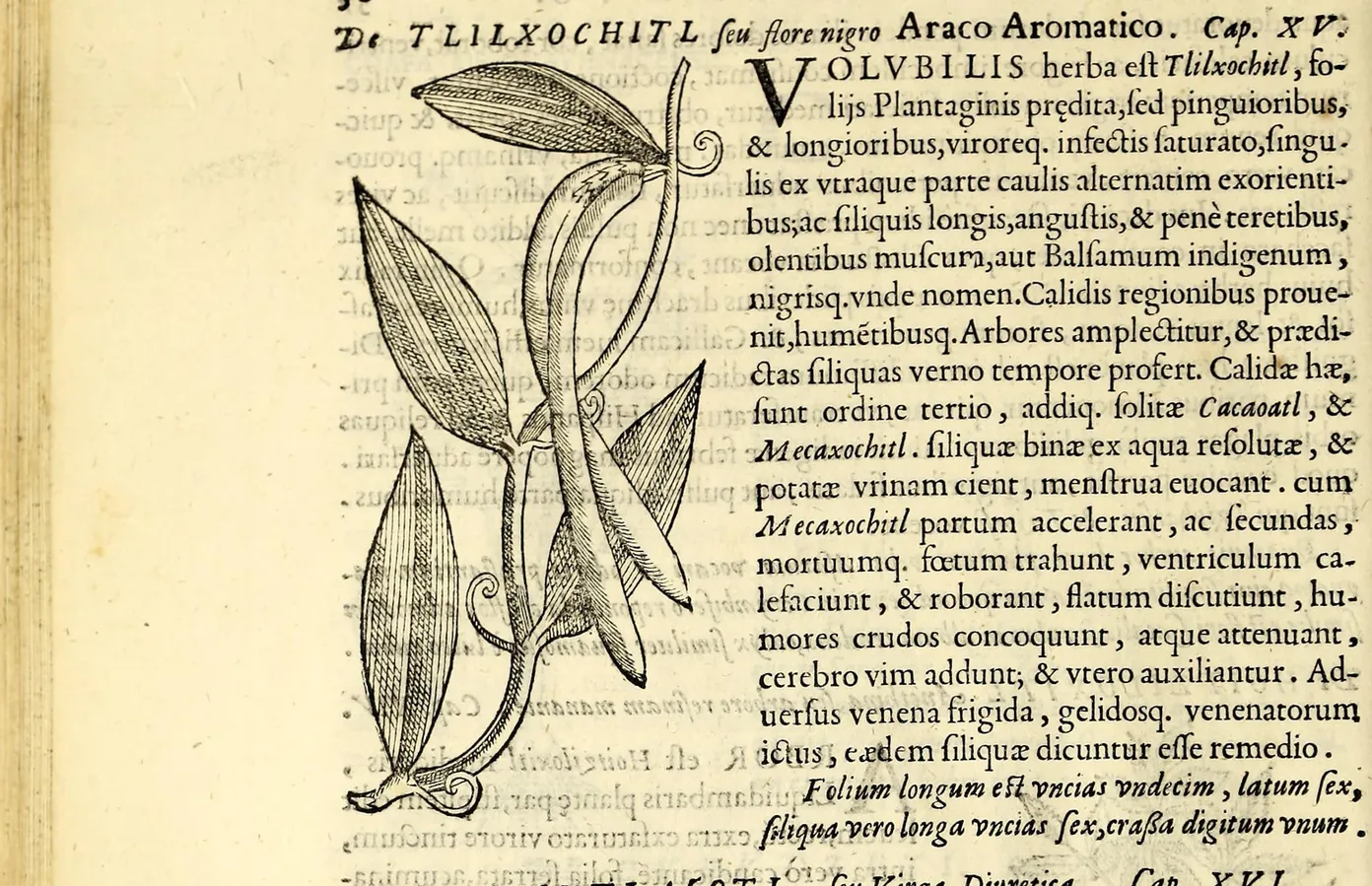
The woodcut takes up the whole left column. The vine clinging on, the alternate leaves, the tendril, 3 hanging pods. It descends from a Nahua painting made in Mexico in the 1570s. The hand that saw the living plant is indigenous, the line that carries it to Rome is Italian.
The flower stays out of frame
One detail becomes visible once you have looked for it. These texts describe the stem, the leaf, the tendril, the pod, the seed. The flower, the one that gives the plant its name among the Totonac, is absent from every one of them.
The reason lies in the plant. The vanilla flower opens in the morning and closes within the day. It lasts a few hours, once a year, on a vine that climbs high into the tree. An observer passing through has every chance of missing it. The pod, for its part, keeps for months.
Europe therefore receives the fruit before the flower. It will take more than 2 centuries to work out the mechanism of that one morning's corolla, up to the gesture told in the hand pollination of vanilla.
75 years between the looking and the page
Hernández returns to Spain in 1577 with 16 volumes. He dies in 1587. The Neapolitan physician Nardo Antonio Recchi draws an abridgement from them. The Accademia dei Lincei takes hold of it at Rome and annotates it for 30 years. The volume appears in 1651 from Vitale Mascardi, under the title Rerum medicarum Novae Hispaniae thesaurus.
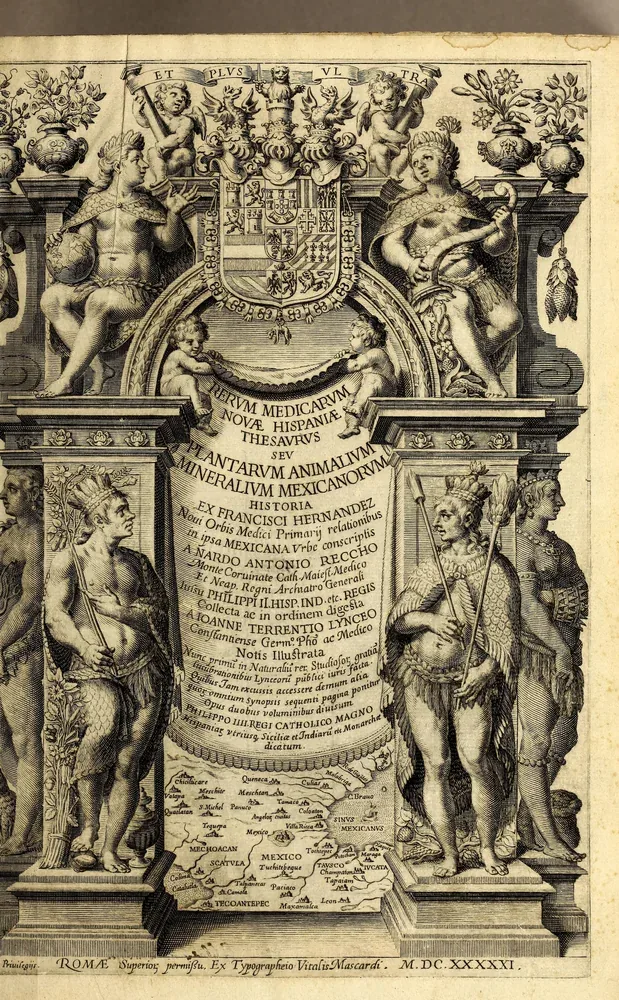
The title carries 4 names before it reaches the subject. Hernández who saw, Recchi who abridged, Terrentius who annotated, Philip IV to whom the work is dedicated. Below the dedication, a map of New Spain sets out the places, Mexico, Tochtepec, Tecoantepec, the Sinus Mexicanus. Around it, caryatids in feather crowns hold up the arch from which the arms of Spain hang.
The codex of 1552 made the same journey, 100 years earlier. Given to the King of Spain, it passes through the hands of Diego de Cortavila y Sanabria, apothecary to the Crown, then enters the library of Cardinal Francesco Barberini, a member of that same Accademia dei Lincei. On 26 June 1626, Cassiano dal Pozzo, secretary to the cardinal, notes in his journal a little book of Mexican remedies2. The 2 oldest European documents on vanilla thus cross paths in a Roman palace, 25 years before one of the 2 goes to press. Charles Upson Clark finds the manuscript again at the Vatican in 1929. John Paul II returns it to Mexico on 7 May 1990.
Learned Europe therefore reads the living vanilla in 1651, from a description made in 1571. Across those 75 years, the cured pod is already moving through the ports. The goods run, knowledge follows on foot.
5 or 6 pods arrive at Leiden
Charles de L'Écluse, whom Latin names Carolus Clusius, keeps the garden of the university of Leiden. In 1605 his Exoticorum libri decem appear, an inventory of everything the ships bring back, plants, fruits, resins, animals.
He works by correspondence. London is one of his best counters. Hugh Morgan, apothecary to Queen Elizabeth, keeps a shop there and has been supplying Clusius for more than 20 years. The Exoticorum keep the trace of those consignments. Fruits obtained from Drake's companions on the return of their voyage round the world. A fragment of yellow sandalwood received in 1581, heavy to the touch, knotted, pale within, sweet in scent. An oil of balsam from the New World, an oil of liquidambar, a stone found in amber. Morgan sends, Clusius describes.
In 1602 a different parcel arrives.
Londino ad me mittebat Hugo Morganus Serenissimae Reginae Angliae Elizabethae pharmacopoeus, anno a nato Christo sexcentesimo secundo supra millesimum, quinos aut senos lobos peregrinos, quid de illis sentirem, meam opinionem exquirens.
From London, Hugh Morgan, apothecary to the most serene Queen Elizabeth of England, sends him 5 or 6 foreign pods in 1602, asking what he makes of them. Clusius frankly admits the difficulty, the material being entirely new to him.
So he does what a botanist knows how to do, he describes. Some measure 6 inches, others 7, a few pass 8. Each one is barely half an inch wide. All are cylindrical and wrinkled, brownish in colour, slightly curved back on the stalk end, blunt at the tip. The silhouette reminds him of certain small horns he remembers observing long ago on terebinth shrubs.
He opens one lengthwise. Inside, a fine black shining dust, clinging tightly to the wall. The smell holds first of benzoin, then it brings on a heaviness of the head in anyone who keeps it long under the nostrils.
Morgan had left the rest blank. Where he had it from, whether it came from a low plant or from a tree, which province produced it, the letter passes over. The chapter closes on the sentence of an honest scholar.
Itaque nemo mirari debet, si plura de illis scribere nequeo.
Let no one wonder, then, if I find myself unable to write more about them.
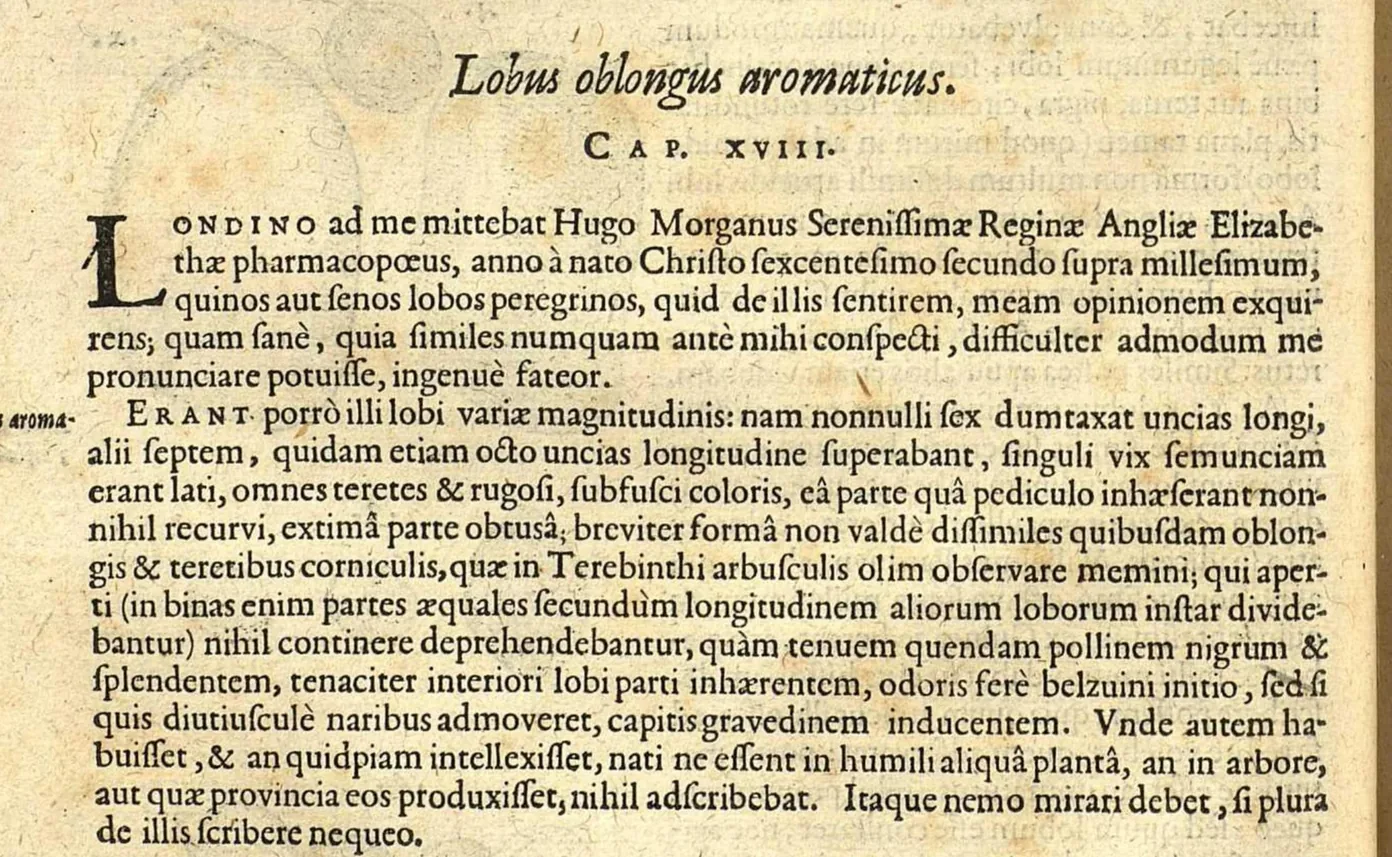
The page carries the title in italic, a drop capital, a note in the margin. The place of the woodcut stays empty. Hernández had a vine on its tree and painters to record it. Clusius has 5 pods on a table at Leiden.
A simple marker
In 1605, learned Europe holds the pod, its smell, its seeds, its dimensions to the inch. The name of the plant, its province and its flower stay in New Spain, in a manuscript that Rome will print 46 years later.
An Andalusian physician writes the dose
Antonio Colmenero de Ledesma holds the title of physician and the experience of the Indies. He publishes at Madrid, in 1631, with Francisco Martínez, a Curioso tratado de la naturaleza y calidad del chocolate. It is the first whole book devoted to the subject. It gives the proportions. It gives 2 of them.
The first is not his. He reports it in the first point of his treatise under the formula « la receta de nuestro Escritor de Marchena », the recipe of our writer of Marchena. It counts 700 cacaos and vainillas de campeche tres6. That is the one Dufour will take up at Lyon in 1685, with its 3 pods to 700 cacaos.
The second is his own. It opens the third point, at folio 8 recto, after a physician's caution: there is no recipe common to all, this one holds for those in health, the others will choose their ingredients according to what suits them. Then comes the dose.
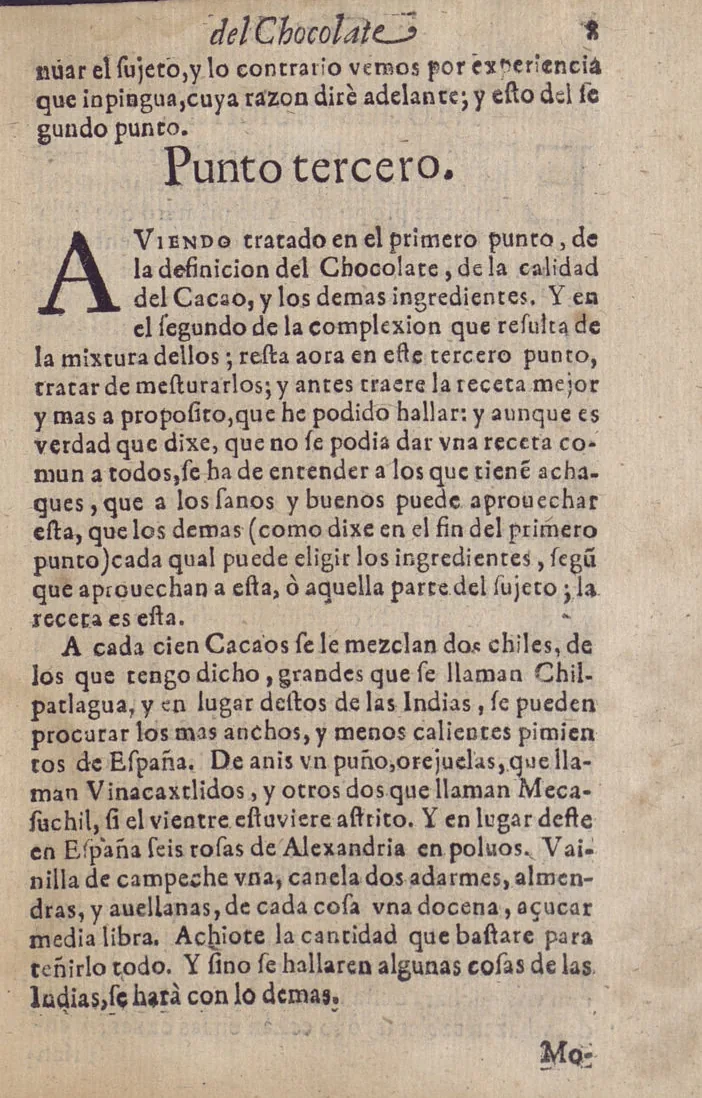
A cada cien Cacaos se le mezclan dos chiles, de los que tengo dicho, grandes que se llaman Chilpatlagua [...] De anis vn puño, orejuelas, que llaman Vinacaxtli dos, y otros dos que llaman Mecasuchil [...] Vainilla de campeche vna, canela dos adarmes, almendras, y auellanas, de cada cosa vna docena, açucar media libra. Achiote la cantidad que bastare para teñirlo todo.
The Castilian of 1631 writes Vainilla de campeche vna. The pod is there, under its name, in the port that ships it. It is that recipe, the one of the 100 cacaos, that English will translate 21 years later.
To every 100. Cacaos, you must put two cods of the long red Pepper [...] called in the Indian Tongue, Chilparlagua [...] One handfull of Annis-seed Orejuelas, which are otherwise called Pinacaxlidos: and two of the flowers, called Mechasuchil [...] One Cod of Campeche, or Logwood: Two Drams of Cinamon; Almons, and Hasle-Nuts, of each one Dozen: Of white Sugar, halfe a pound: of Achiote enough to give it the colour.
One pod to 100 cacaos. And the triad is there, whole, 79 years after the painted page of Tlatelolco. The orejuela is the hueynacaztli of folio 56 verso, the mechasuchil its mecaxochitl, the pod its tlilxochitl. 3 Nahuatl names hold inside a recipe printed at Madrid, carried by the hands that grind cacao on the metate.
The method follows, precise as a prescription. Dry each ingredient apart, grind them one by one, begin with the cinnamon, go on to the chilli and the aniseed, finish with the achiote that gives the colour. Keep stirring to hold the powder pale, a burnt powder turns bitter and loses its virtue. The paste forms over a low fire, is poured onto paper or onto a banana leaf, cools into a tablet. Vanilla enters the chocolate as a powder, at the first stage, with the cinnamon.
Colmenero writes as a physician. He is happy to say so. This recipe suits whoever is in health, for the sick one adds or takes away according to the complexion of each. He discusses the cloves that others put in, judges them binding, then quotes 2 Latin verses in support of his opinion. He defends the aniseed, hot in the third degree, which tempers the coldness of the cacao. Chocolate is still an apothecary's preparation, where vanilla holds the part of one simple among others.
The pod passes for a dyewood
The English text of 1652 says exactly what becomes of vanilla when it changes language. Colmenero names it by its port of shipment, Campeche. James Wadsworth reads that place name alone. He renders it as the commodity that port has been sending to England for a century, the dyewood.
One Cod of Campeche, or Logwood12
Elsewhere in the same book, the description gives the substitution away. These pods smell of fennel, he writes, everyone puts them in because they are mild in heat. An aniseed-scented pod that perfumes chocolate is a vanilla pod. It survives in the English text under the name of a wood for dyeing.
The detail lights up a line that all the recipes of the following century carry. When vanilla runs short, aniseed takes its place, at 2 ounces to 3 pods. Europe first filed this pod on the side of the note it knew how to name.
What Lyon receives in 1685
Colmenero's book travels. Translated into French in 1643, into Latin in 1644, into English in 1652. It becomes the reference text on which everyone who writes about chocolate afterwards leans.
In 1685, the Lyon apothecary Philippe Sylvestre Dufour takes up the first of the 2 recipes with its doses, 3 pods to 700 cacaos, in Traitez nouveaux & curieux told in detail by vanilla under Louis XIV7.
The same Dufour devotes a chapter to it and opens it thus, “La Vanille que d'autres apellent Mecaxuchil”. 133 years after folio 56 verso, 2 of the 3 plants painted side by side have become a single word. The material holds, knowledge narrows.
The name that won
Castilian settles it. Vainilla, a diminutive of vaina, the sheath, meaning the little sheath. From it come the Italian vaniglia, the French vanille, the English vanilla, the German Vanille. The word travels with the crates.
3 American languages had named this plant before it. Totonac named a hidden flower. Maya named a fragrant vine. Nahuatl named a black pod. Castilian named a container.
The name that won is the warehouse's. Those that spoke of the flower and of the vine stayed on the coast, in the mouths of the people who grew it. The name Bourbon will follow the same slope 2 centuries later, taking that of an island and of a dynasty.
What this century lays down in a pod
The material travels faster than the knowledge of it. In 1552, a Nahua physician paints it as a herb and hangs it round a traveller's neck. In 1602, at Leiden, the leading botanist of Europe holds 5 pods and looks for the plant. In 1651, Rome prints the vine that carries them, drawn 80 years earlier. In 1841, a teenager on Réunion finds the gesture that fertilises it. Cultivation settles in Madagascar around 1870, as told in the origin of vanilla, from Mexico to Madagascar.
The aromatic spectrum crosses these 3 centuries intact. Martín de la Cruz puts it in a travelling scent, Sahagún in a cacao, Hernández writes musk and balsam, Clusius writes benzoin. These are the notes that the hand of today finds again on a sorting table at Antalaha, in a pod supple and rich in oils, with black glossy seeds.
One thing shifts, all the same. These texts hold vanilla to be a single material, designated by a port. A pod from Campeche, and the matter is closed. 3 centuries of soils, of climates and of hands have added the possibility of naming a slope, a season, a way of working within an aromatic spectrum. Maturation in rosewood trunks gives the longest measure of it today.
Madagascar carries terroirs the world is only beginning to discover. We open them lot after lot.
To follow the rest of the journey, explore our varieties and terroirs, discover our craft, or let us talk about your project.
Professional reference
Connect the reference to the actual material: touch, scent, infusion and intended use together form a complete reading.
Frequently asked questions
What is the oldest written name of vanilla?
Tlilxochitl, in Nahuatl, from tlilli meaning black and xochitl meaning flower. The word appears on folio 56 verso of the de la Cruz-Badiano codex, a herbal composed in 1552 at the college of Santa Cruz de Tlatelolco by the Nahua physician Martín de la Cruz and translated into Latin by Juan Badiano. The plant is painted there beside mecaxochitl and hueynacaztli, under a recipe for a scent worn round the traveller’s neck.
What do the Totonac and the Maya call vanilla?
The Totonac of the gulf coast call it xanat. The dictionary of the Academia Veracruzana de las Lenguas Indígenas gives that word 2 senses held together, the flower above all others and vanilla. A study published in 2019 records the form Axi-Xanath, which Spanish renders as flor recóndita, the hidden flower. The Maya of Yucatán and Petén name it sisbic, or sisbic-ak, the fragrant vine. A survey published in 2019 still records 11 living names in Quintana Roo and Yucatán.
Where does the word vanilla come from?
From the Castilian vainilla, a diminutive of vaina, the sheath, meaning the little sheath. From it come the Italian vaniglia, the French vanille, the English vanilla and the German Vanille. The word describes the shape of the goods, where the American languages described the flower, the vine or the colour of the cured fruit.
Who described vanilla first in Europe?
The botanist Carolus Clusius, in his Exoticorum libri decem published at Leiden in 1605. Hugh Morgan, apothecary to Queen Elizabeth, had sent him 5 or 6 pods from London in 1602, asking for his opinion. Clusius measures them, opens them, describes the black dust and the smell of benzoin, then writes that the provenance and the plant remain unknown to him. The description of the living vine by Francisco Hernández, made in Mexico around 1571, would be printed at Rome in 1651.
Sources
- De la Cruz M., trans. Badiano J. (1552). Libellus de medicinalibus Indorum herbis, Codex Barberini lat. 241, folio 56 verso. Biblioteca Nacional de Antropología e Historia, Mexico. Folio in the public domain. commons.wikimedia.org
- Gómez P. L. D. (2008). Vanilla planifolia, the first Mesoamerican orchid illustrated, and notes on the de la Cruz-Badiano Codex, Lankesteriana 8(3), Universidad de Costa Rica. lankesteriana.org
- Sahagún B. de. Historia general de las cosas de Nueva España, ed. C. M. de Bustamante, Mexico, 1829, vol. 3, p. 97. The bilingual manuscript of 1577 is available in facsimile. florentinecodex.getty.edu
- Hernández F. (1651). Rerum medicarum Novae Hispaniae thesaurus, seu Plantarum animalium mineralium Mexicanorum historia, Rome, Vitale Mascardi, book III, chap. XV, p. 38. Copy of the John Carter Brown Library. archive.org
- Clusius C. (1605). Exoticorum libri decem, Leiden, book III, chap. XVIII, p. 72. archive.org
- Colmenero de Ledesma A. (1631). Curioso tratado de la naturaleza y calidad del chocolate, Madrid, Francisco Martínez. Biblioteca Nacional de España, copy U/5396, digital facsimile. bdh.bne.es
- Dufour P. S. (1685). Traitez nouveaux & curieux du café, du thé et du chocolate, Lyon, Jean Girin and Barthélemy Rivière. archive.org
- Barrera-Rodríguez A. et al. (2019). Exploración actual sobre el conocimiento y uso de la vainilla en las Tierras Bajas Mayas del Norte, Yucatán, Polibotánica 48, p. 169-187. scielo.org.mx
- Berdan F. and Anawalt P. (1997). The Essential Codex Mendoza, University of California Press. The record of the Tochtepec tribute, folios 45v and 46r, carries cloth, a warrior costume, gold, jadeite beads, lip ornaments, feathers, 1,600 rubber balls, 100 pots of liquidambar and cacao. This register holds the imperial quotas on a limited set of goods, cacao among them. Vanilla travelled by the market, see source 10.
- Sahagún B. de. Florentine Codex: General History of the Things of New Spain, trans. A. J. O. Anderson and C. E. Dibble, School of American Research and University of Utah, book VIII, chap. 19, then book X. The chapter on the Tlatelolco market carries, in Nahuatl, nonqua onoca in quinamaca cacaoatl, uei nacaztli, tlilxochitl, a stall held apart for cacao, hueynacaztli and vanilla. Book X places vanilla in the stock of the seller of dyes and drugs. It climbed towards the highlands through trade.
- Lubinsky P., Bory S., Hernández Hernández J., Kim S.C., Gómez-Pompa A. (2008). Origins and Dispersal of Cultivated Vanilla (Vanilla planifolia Jacks. [Orchidaceae]). Economic Botany 62(2), 127-138. doi.org/10.1007/s12231-008-9014-y
- Colmenero de Ledesma A., trans. Wadsworth J. (1652). Chocolate: or, An Indian Drinke, London, John Dakins. English translation of the 1631 treatise.
- García Ramos C. (2007). Diccionario Básico Totonaco-Español / Español-Totonaco, 1st edition. Academia Veracruzana de las Lenguas Indígenas, Secretaría de Educación de Veracruz. Entry « Xanat s. Flor por excelencia. Vainilla ». In the Spanish-Totonac part, « Vainilla. Xanat ». aveligob.mx
- Lubinsky P., Bory S., Hernández Hernández J., Kim S.C., Gómez-Pompa A. (2008). Origins and Dispersal of Cultivated Vanilla (Vanilla planifolia Jacks. [Orchidaceae]). Economic Botany 62(2), 127-138. doi.org/10.1007/s12231-008-9014-y
- Colmenero de Ledesma A., trans. Wadsworth J. (1652). Chocolate: or, An Indian Drinke, London, John Dakins. English translation of the 1631 treatise.
- García Ramos C. (2007). Diccionario Básico Totonaco-Español / Español-Totonaco, 1st edition. Academia Veracruzana de las Lenguas Indígenas, Secretaría de Educación de Veracruz. Entry « Xanat s. Flor por excelencia. Vainilla ». In the Spanish-Totonac part, « Vainilla. Xanat ». aveligob.mx