The name Bourbon has accompanied Indian Ocean vanilla for so long that it passes for self-evident. It carries a dated history all the same, one that begins with the christening of an island and continues in the quotation columns of French ports. Following it gives the name its true reach.
An island taken in the name of the king
The island already bore a Portuguese name, Mascareigne, inherited from Pedro Mascarenhas. French navigators were still using it in the early 17th century. France gained a foothold there in stages. The episode that concerns us plays out from Fort-Dauphin, in Madagascar.
Étienne de Flacourt, who ran the French concession, wanted possession of that neighbouring island confirmed. He instructed captain Roger Le Bourg, aboard the Saint-Laurent, to sail there. The first time, the captain passed well clear of it. Flacourt noted that he had steered off course to excuse himself from the task.
So Flacourt sent the ship back, this time with a formal order. The historian A. Malotet, working in 1898 on Flacourt's papers, reports what followed1.
This time he gave the captain Le Bourg the formal order to call at the island of Mascareigne, to take possession of it in the name of the king, and to leave there four heifers and a bull, so as to multiply the species. Such was the captain's ill will that he took more than five weeks to reach that island, to which he gave the name of Bourbon, and that he returned bringing nothing back from his voyage.
The account reads in 2 roles. Flacourt gives the name, Le Bourg carries out the taking of possession. The institutional portal devoted to the history and memory of slavery on La Reunion puts it this way, in 1649 Flacourt, from Fort-Dauphin, names it île Bourbon16. He justified that choice by the goodness and fertility of the island. The captain carries the act onto the coast, in the name of the king. The common account readily hands the name to the sovereign himself.
The date calls for caution. Malotet places this sentence between two dated markers, June 1649 on one side, a document of 18 February 1650 on the other, the Saint-Laurent sailing again on 19 February. The year 1649 is the one commonly read and it remains consistent with the thread of the text.
Bourbon, the name of a reigning house
The same work sheds light on the choice of name 22 pages further on. Flacourt, describing the submission of a defeated chief, requires him to acknowledge « Louis de Bourbon as his king, his lord and his master »1.
Bourbon names a reigning family first. The expedition lays on the island the name of the house in power, as was then done for newly recognised lands. The name would pass from a dynasty to an island, then from an island to a commodity. The reign of Louis XIV, when vanilla reaches Paris, would thus leave its patronymic to a pod it knew at the time from Mexico.
1846, the name enters the quotations
200 years later, the name has left geography for bookkeeping. On 26 May 1846, the Bordeaux newspaper L'Indicateur published, under the heading « Sales at Le Havre, 23 May », the report of the auctions held on that exchange2. The column runs through the colonial commodities, Louisiana cotton, Mobile cotton, Havana sugar, Haiti coffee, New Orleans hides, Carolina rice. In the middle, vanilla.
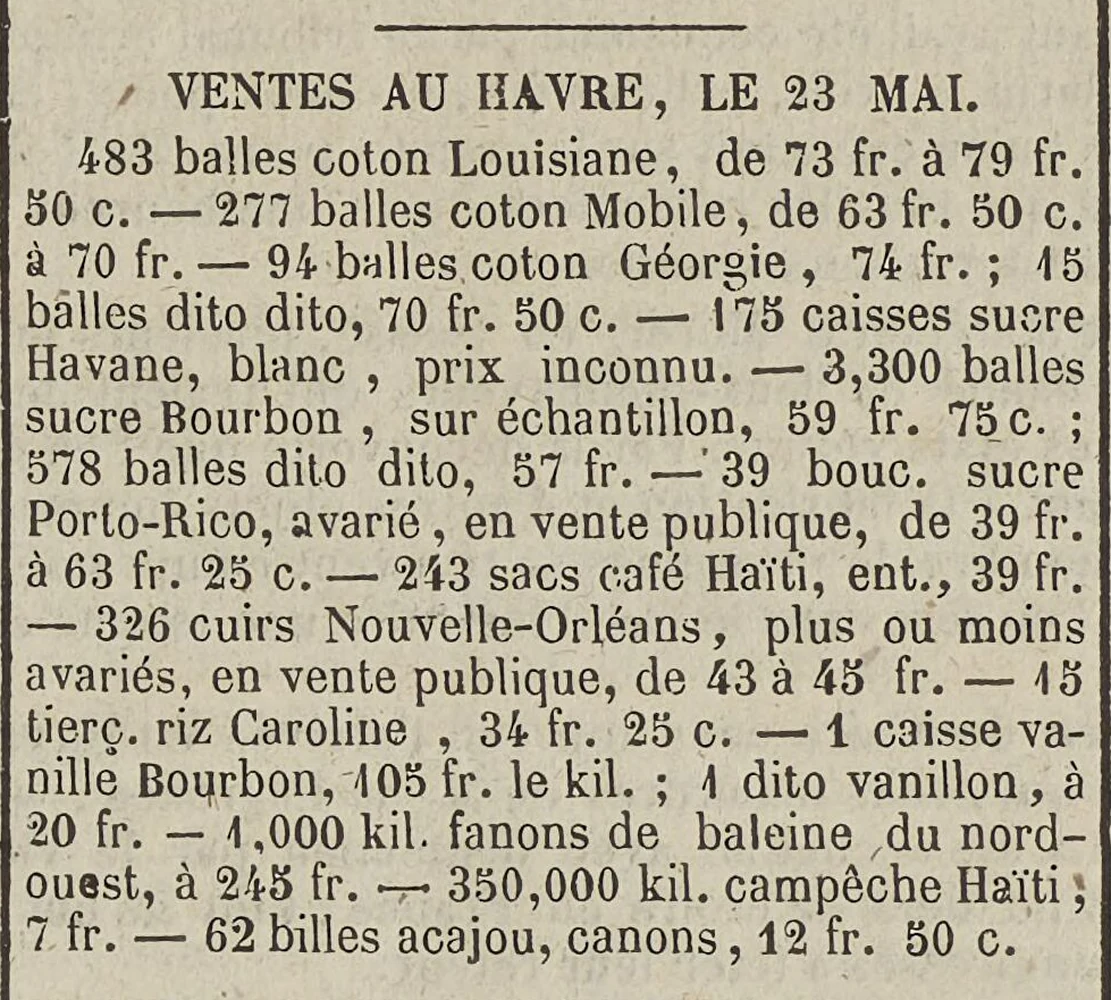
3,300 bales Bourbon sugar, on sample, 59 fr. 75 c. [...] 1 case Bourbon vanilla, 105 fr. per kg. ; 1 ditto vanillon, at 20 fr.
These are auction prices. The ratio with vanillon, which is Vanilla pompona, exceeds 5. Buyers in 1846 already hold these materials to be distinct. On what these registers cover today, see Planifolia, Tahitensis, Pompona.
The sugar supplies the decisive element. Bourbon works as a colonial trade prefix of origin, applied to sugar as to vanilla, exactly as one wrote Havana or Carolina in the same column. The name files a provenance in a market table.
1871, an entry in a catalogue
25 years later, the name has reached the advertising pages. The Soupe house, at 21 rue Neuve-Saint-Merry in Paris, had its notice inserted in a treatise on winemaking. It addresses distillers and confectioners. Its notice lists distilled waters, essences and curaçaos. 2 entries suffice to file its vanilla offer3.
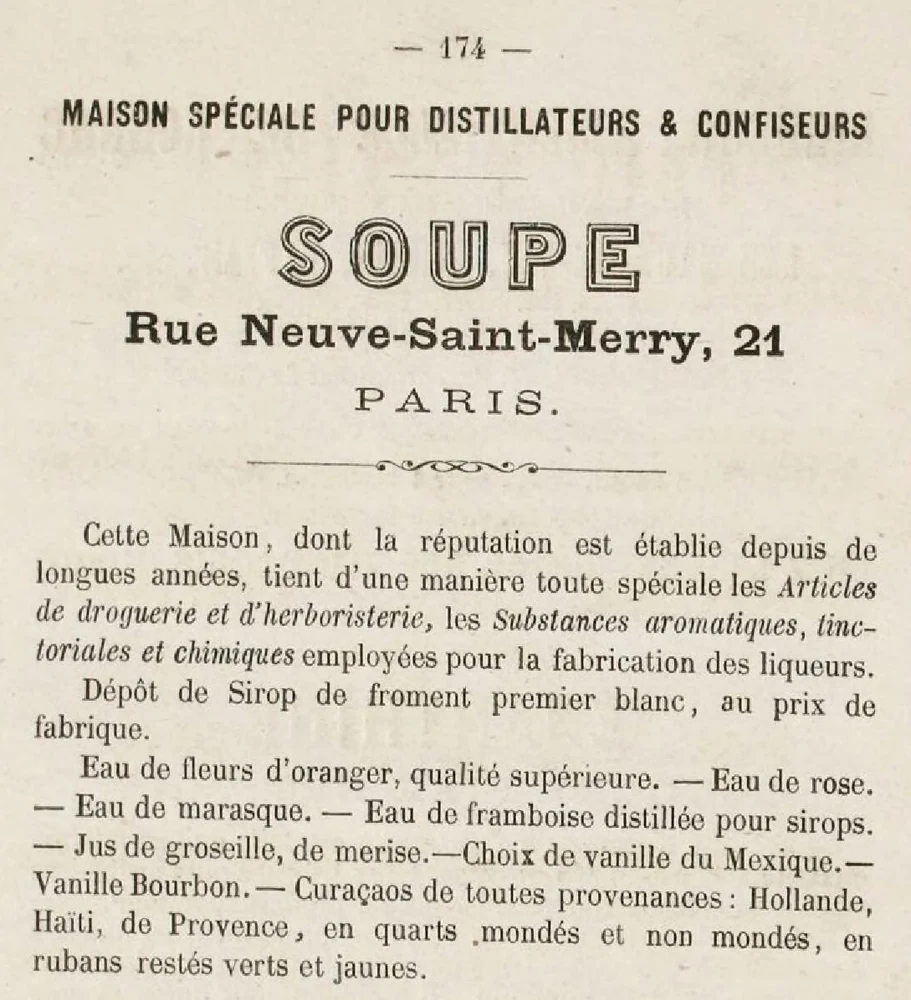
This page is an advertisement, bought by the house and inserted in the work. Its value lies precisely there, it shows the vocabulary of a seller addressing professionals. The name has become an entry in a catalogue.
1899, the professional description
By the end of the century, the name carries a complete physical description. The Journal des confiseurs, glaciers, chocolatiers of 1 November 1899 devotes to vanilla a passage addressed to exactly the readership these pages have in view today. It describes the sweating on a woollen blanket, the oven stage at 140 degrees Fahrenheit, the coating with cashew oil or melted cocoa butter, then 2 months of sun and the sorting4. On preparation as we conduct it, see our savoir-faire.
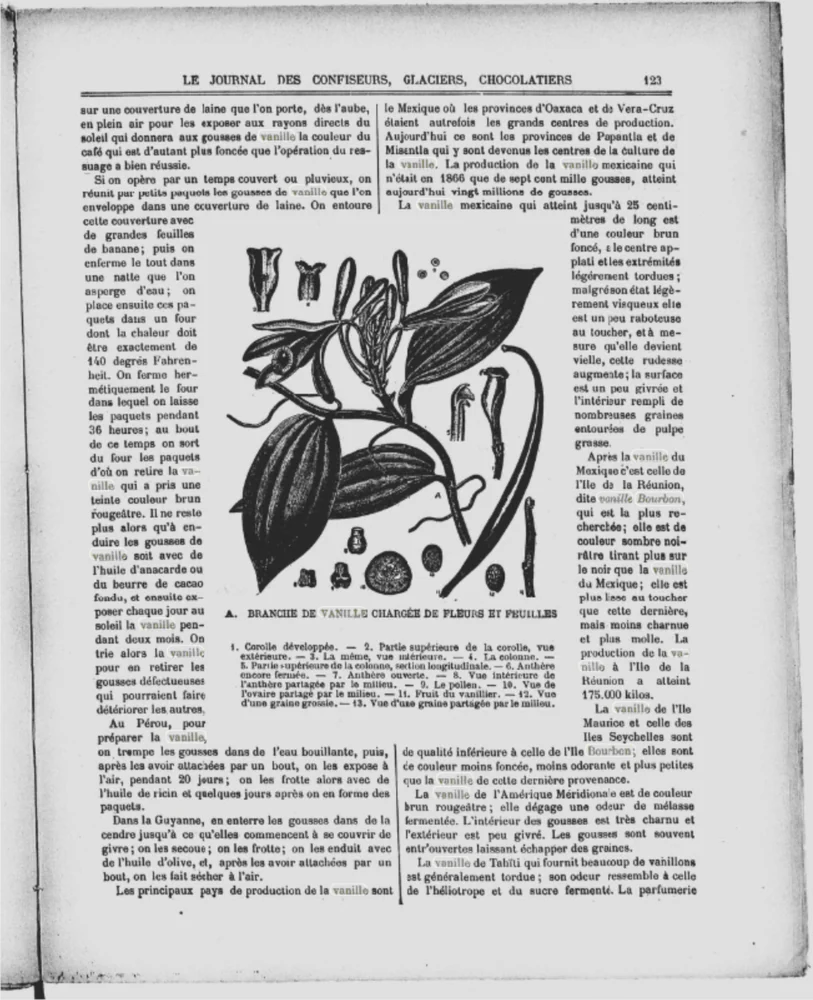
After Mexican vanilla it is that of the Island of Reunion, called Bourbon vanilla, which is the most sought after ; it is of a dark blackish colour tending more towards black than Mexican vanilla ; it is smoother to the touch than the latter, but less fleshy and softer.
The sentence sets a clear equivalence. Bourbon, in 1899, means La Reunion. The text confirms it at once by giving the other islands their own rank, since « the vanilla of the Island of Mauritius and that of the Seychelles Islands are of inferior quality to that of the Island of Bourbon »4.
The same article gives the orders of magnitude of its day. Production on La Reunion reaches 175,000 kilos. Mexican production, which stood at 700,000 pods in 1866, reaches 20 million pods. It also describes the frauds of the time, with doctored pods slipped into the middle of bundles and a frosting obtained with acid, which invites close examination of the pods in the middle of a bundle. The frost born of the pod itself is the subject of a page of its own.
1910, Bourbon and Madagascar on two lines
The Journal d'agriculture tropicale of 1910 completes the movement. The name is an entry in a table there. That table says something the usage of today has erased5.
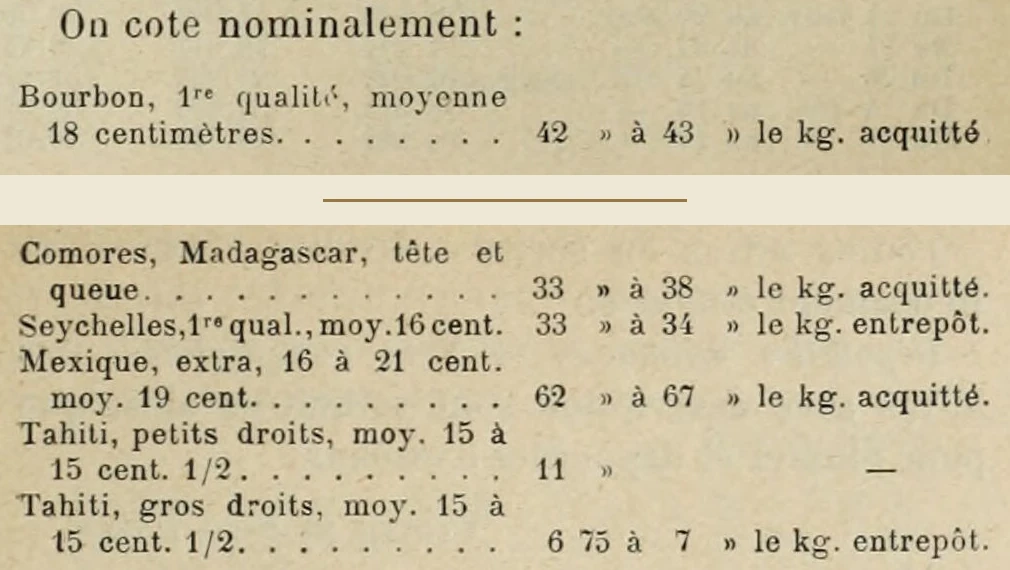
Bourbon, the Comoros with Madagascar, the Seychelles, Mexico and Tahiti occupy distinct quotation lines. The January issue files them the same way, writing this time « Comoros, Mayotte ». The campaign commentaries speak the same language. The writer notes that « Bourbon vanillas are only just beginning to arrive » and that 2/3 of the harvest is already dealt « between 25 and 32 according to merit, taken at Bourbon ». The sentence that follows opens another paragraph, « On the Madagascar side, the first lots have also made their appearance »5.
Quality is read inside the name, since the price list files grades and averages under a single entry, with prices varying according to merit. The name keeps in 1910 the meaning it had in 1846, that of one precise island. The same volume also quotes Bourbon geranium at 27 to 28 fr. and reports a small arrival of vetiver from Bourbon, the prefix remaining what it was, an indication of provenance applied to everything coming off that island.
A price list separates what is quoted separately. These columns therefore establish a quotation practice, the everyday language of the time having been able to remain looser. The constancy of the division over more than 60 years is telling all the same.
How the word widened
Between the price list of 1910 and present usage, the word changed perimeter. Today, Bourbon commonly designates the Planifolia vanillas of Madagascar, the Comoros and La Reunion. The date of that shift is still being sought.
One date circulates everywhere. In 2004, the geographer Judith Klein writes that the Bourbon variety « corresponds to a denomination created in 1964 »7. She sets the sentence down as it stands. Her bibliography refers to Jumelle in 1914 then to Bois in 1934, both far earlier. The online encyclopedia and the sales pages then take it up hand to hand.
The Journal officiel, for its part, carries the word on Malagasy pods before that date. On 30 June 1960, in the Assemblée nationale, the deputy Frédéric de Villeneuve pleads for the productions of La Reunion and puts the question to the minister of State11.
Bourbon vanilla is highly prized on the international market. Its denomination Vanille Bourbon is therefore envied by other countries. Madagascar, for example, sells a large part of its vanilla under that name.
4 years before the date that circulates, the word therefore already accompanies the vanilla of Madagascar, widely enough for a deputy to make it a matter for the floor. Commercial usage is in place before 1964.
1964 remains a pivotal year all the same, but for another reason. A protocol is signed in March between the Comoros, La Reunion and Madagascar, « to stagger deliveries and halt the fall in prices », according to the report read to the Assemblée on 22 October that year12. A Senate report of 1967 says the same in the same terms, speaking this time of staggering sales17. The 3 producers of the Indian Ocean organise their market.
The context is known. A floor price raised to 15 US dollars a kilo for the 1962 crop had brought on the crisis of 1963, Malagasy exports falling from 639 to 292 tonnes. In February 1964, the conference of Saint-Denis de La Reunion brings together the representatives of the 3 neighbouring producing countries of the Indian Ocean, Madagascar, the Comoros and La Reunion, which decide to harmonise their commercial policy on vanilla, setting prices and quotas18.
A first conference follows at Tananarive, the same year, bringing together this time the producing countries of the Indian Ocean with the representatives of importers and users. It concludes on a floor selling price of 10.20 US dollars a kilo FOB for export from Madagascar, slightly different prices for La Reunion and the Comoros, purchase commitments from American importers and the promise of a promotional campaign for the natural product in the United States18.
The same year, American regulation shifts. On 22 December 1964, the Federal Register publishes the recast of the rules applying to frozen desserts, which separates vanilla flavour from artificial flavour and sets an effective date at 180 days13. The deadline is postponed, then fixed at 31 December 196514. Jennings places in 1965 the commercial turning point that follows, demand for pods rising again6.
A protocol then brings together in January 1966 Madagascar, the Comoros and La Reunion to allocate export quotas towards the United States and towards Europe6. These documents speak of deliveries, quotas, prices and markets. The vocabulary of denominations remains foreign to them. None of the sources we have been able to consult establishes, however, the creation in 1964 of a label or a denomination « Vanille Bourbon ».
The law brings its own texts. The French decree of 20 May 1966, still in force, defines vanilla by its botany and by its mode of preparation9. The protected geographical indication registered on 27 August 2021 is called Vanille de l'île de La Réunion and delimits 8 communes on the windward coast10. It protects that denomination for the Reunionese area and its specification. It does not protect the word Bourbon across the Indian Ocean. These texts name a plant and an island. The word Bourbon, for its part, lives in usage.
The oldest normative trace at our disposal for a widened Bourbon dates from 1999. The ISO 5565-1 standard notes then, in its scope, that this vanilla « is commercially known under various names associated with its geographical origin, namely: Bourbon vanilla (from Madagascar, the Comoros and Reunion), Indonesia, Mexico, Tonga, India, China, Uganda »8. It is a note, recording a usage of the trade. Earlier editions exist, ISO 3493 of 1976 and ISO 5565 of 1982, withdrawn since then and whose text is not accessible to us.
The standard also frames the species. Its specifications cover Vanilla fragrans alone, synonym of Vanilla planifolia. The name Bourbon therefore attaches to that species in the normative text that writes it.
Standardised vocabulary takes up the same reading 15 years later. ISO 3493 of 2014, which sets the terms of the trade, places Vanilla planifolia among the species commercially known under various names associated with geographical origin, such as Bourbon, Indonesia and Mexico15. The 2 standards do not draw up exactly the same list. They agree on the point that concerns us, Bourbon there is a trade denomination attached to a provenance.
What the name carries
Bourbon names a heritage and a provenance. A reigning house, an island taken in the name of the king, then 150 years of trade registers where the word designates La Reunion. The usage of the 20th century then extends it to the wide Indian Ocean basin, where the SAVA holds first place today.
Reading a vanilla therefore begins after the name. The quotations of 1910 said as much in their own way, filing grades and averages under a single entry. Today that reading is conducted lot by lot, harvest maturity, preparation, robe, suppleness, raw aroma, behaviour in infusion. Time takes a part in it that the trade of the 19th century knew nothing of, that of long maturation.
This is the work we carry out in Madagascar, terroir by terroir, to open to the world terroirs that the trade is only just beginning to name. For what follows, explore our terroirs, the pollination gesture that opens every pod, as well as the arrival of vanilla at Bourbon and then in Madagascar.
Professional reference
Bourbon lives in commercial usage and in a note of an international standard, outside the regime of protected designations, whose European machinery dates from 1992.
Frequently asked questions
What does the name Bourbon designate?
Bourbon comes from the island that bore the name of the reigning house of France, today La Reunion. In the trade of the 19th century, the word designates that island alone. Present usage extends it to the Planifolia vanillas of Madagascar, the Comoros and La Reunion.
Is Bourbon vanilla a protected designation?
The name lives in commercial usage and in the notes of the ISO 5565-1 and ISO 3493 standards. The official European sign existing is the protected geographical indication Vanille de l’île de La Réunion, registered on 27 August 2021, which protects that denomination for its Reunionese area and not the word Bourbon across the Indian Ocean.
Where does the frequently cited date of 1964 come from?
It circulates from a mention published in 2004, which its author sets down as it stands. The debates of the Assemblee nationale show that Madagascar already sells its vanilla under the name Bourbon in 1960. 1964 remains a pivotal year, with a protocol signed in March between the Comoros, La Reunion and Madagascar to stagger deliveries, then the recast of American labelling in December. No document recovered creates a Vanille Bourbon label there.
Does Bourbon designate a variety of vanilla?
The name attaches to Vanilla planifolia, the only species covered by the specifications of the ISO 5565-1 standard. It indicates a provenance inside that species.
Sources
- Malotet A. (1898). Étienne de Flacourt ou les origines de la colonisation française à Madagascar, 1648-1661. Paris, pages 123, 124 and 145. archive.org
- L'Indicateur, Bordeaux, 26 May 1846, column « Ventes au Havre, le 23 mai ». Bibliothèque nationale de France, Gallica, ark:/12148/bd6t527168429, view f4. gallica.bnf.fr
- Advertisement of a wholesale house on rue Neuve-Saint-Merry, inserted in Lunel B. (1871). Traité de la fabrication des vins, 2nd edition, Paris, page 174. Gallica, ark:/12148/bpt6k10983057, view f180. gallica.bnf.fr
- Le Journal des confiseurs, glaciers, chocolatiers, fabricants de confitures, conserves, fruits confits, sirops, liqueurs, 1 November 1899, pages 123 and 124. Gallica, ark:/12148/bpt6k6586257z. gallica.bnf.fr
- Journal d'agriculture tropicale, volume 10 (1910), price lists and campaign chronicles. archive.org
- Jennings E. (2025). La politique de la vanille à Madagascar, 1960-1985. Histoire@Politique 56. Protocol of 28 January 1966, Archives diplomatiques de Nantes, 673PO 1. doi.org/10.4000/149bl
- Klein J. (2004). La vanille Bourbon à La Réunion. Géographie et cultures 50. journals.openedition.org
- International Organization for Standardization (1999). ISO 5565-1, Vanilla [Vanilla fragrans (Salisbury) Ames] - Part 1: Specification. Clause 1, scope. iso.org
- French decree no. 66-319 of 20 May 1966 relating to vanilla, Journal officiel of 26 May 1966. legifrance.gouv.fr
- Commission Implementing Regulation (EU) 2021/1405 of 20 August 2021, registering the protected geographical indication « Vanille de l'île de La Réunion », Official Journal of the European Union L 303 of 27 August 2021, page 3. eur-lex.europa.eu and inao.gouv.fr
- Assemblée nationale, Journal officiel, Débats parlementaires, year 1960 no. 42, 2nd sitting of Thursday 30 June 1960, page 1618. Speech by M. Frédéric de Villeneuve. archives.assemblee-nationale.fr
- Assemblée nationale, Journal officiel, Débats parlementaires, sittings of 22 October 1964, page 3819, report on the economic situation of the overseas territories, section Les Comores. archives.assemblee-nationale.fr
- Federal Register, volume 29 no. 248, 22 December 1964, page 18123, Part 20 Frozen Desserts. U.S. Government Publishing Office. govinfo.gov
- Federal Register, 28 December 1965, page 16107, Part 20 Frozen Desserts, « Order Postponing Effective Date for Certain Labeling Requirements in the Standard of Identity for Ice Cream ». govinfo.gov
- International Organization for Standardization (2014). ISO 3493, Vanilla - Vocabulary, 3rd edition, July 2014. iso.org
- Portal « Société de plantation, histoire et mémoires de l'esclavage à La Réunion ». Attribution of the name in 1649 by Flacourt from Fort-Dauphin. portail-esclavage-reunion.fr. Primary work of reference, Flacourt É. de (1658). Histoire de la grande isle Madagascar, Paris, BnF record ark:/12148/cb33991767n
- Sénat, Rapport d'information no. 14, first ordinary session of 1967-1968, annex to the minutes of the sitting of 9 November 1967, mission to La Reunion and the Comoros, page 74. senat.fr
- Service de presse et d'information des Communautés européennes (1966). Produits et échanges des pays en voie de développement, no. 5, June 1966, document 6.206/PI/66-F, section « Vanille, aperçu du marché mondial », pages 20 and 21. Digital repository, Archive of European Integration, University of Pittsburgh. aei.pitt.edu