Pale crystals surface on certain pods. They carry a Malagasy name, a molecule and a concentration threshold. This page describes frost, the forms it takes and the molecules that compose it.
Vanillin comes to the surface
Frost is the crystallisation of vanillin on contact with the air. In a long-matured pod, vanillin reaches a concentration such that it migrates from the heart of the matter towards the surface, where it takes a solid form. The crystals settle slowly, over the months spent in the silence of the rosewood.
Pods split when they reach full maturity. Among them, some carry a load of vanillin such that contact with the air, during maturation, raises the frost. Whole pods carry it more rarely. Our marokintana lots bring the two together.
Frost crowns a maturation. It is its visible trace, on the surface of a pod that has had the time to go to the end of itself.
Marokintana, many stars
In Malagasy, marokintana means many stars. The word also names the whale shark, a visitor to the Malagasy coasts. Here it evokes the countless grains of frost that glitter on the surface of the pods after a very long maturation.
At ANTOKALY it names the frosted pods, recognisable by their aromatic intensity.
The 2.3 % threshold
Frost appears on pods whose vanillin content passes beyond 2.3 %. This reference announces a high concentration, reached at the end of a long maturation.
The figure joins the readings of the house: richness in oils, suppleness, regularity of the lot, robe, aromatic beam. A pod is read through all of these signs.
The forms of frost
Frost takes several forms, sometimes within a single harvest. Filaments or dots, the light reveals them at once, in a multitude of reflections. This is the sky that the name marokintana holds.
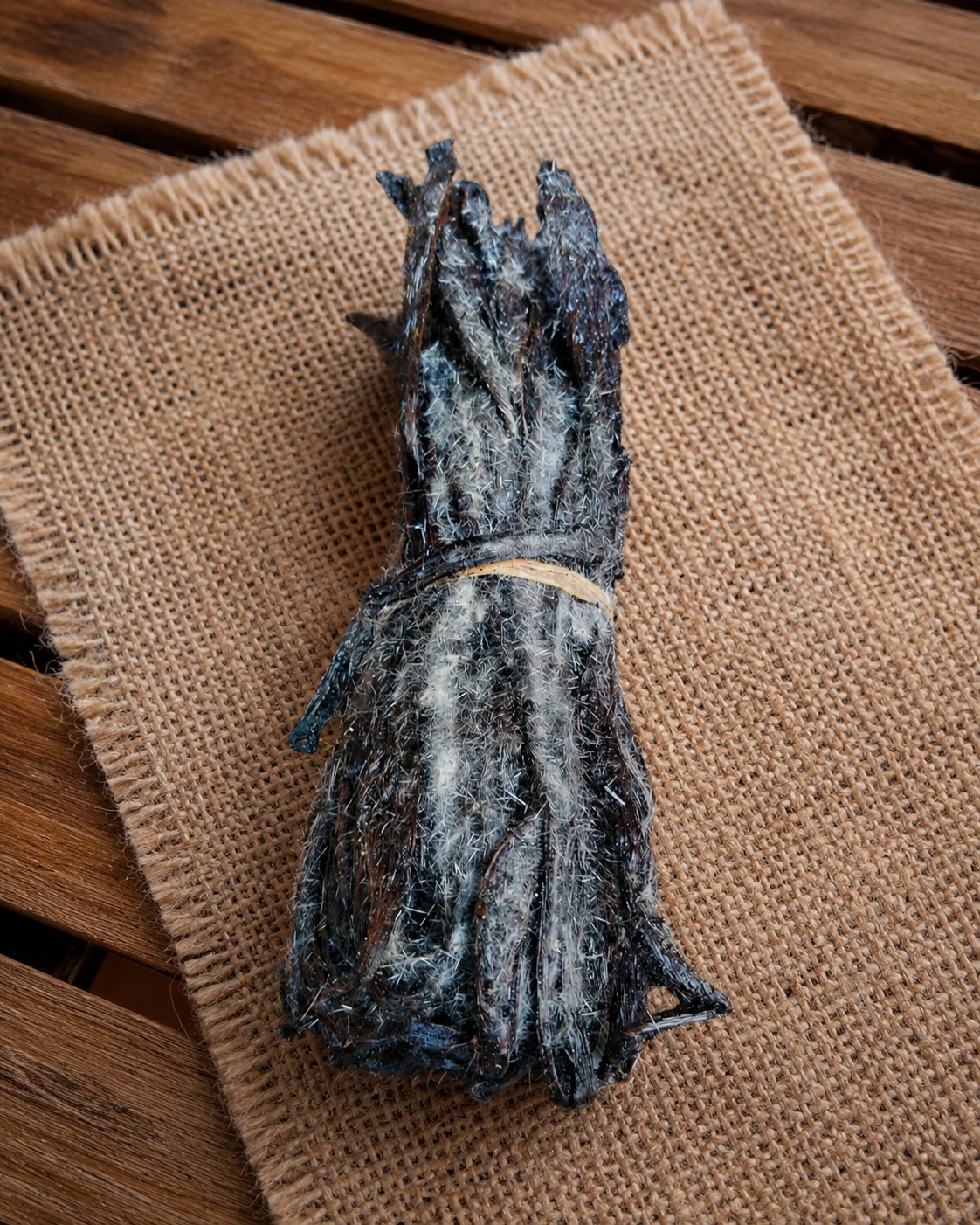
The long crystals
Some crystals stretch into fine filaments, sometimes as long as a hair. They grow in every direction, bristle the surface, draw pale lines on a dark robe. This form calls for a very long maturation and a stable atmosphere.
The dots
Others settle in small white crystals that belt the pod, scattered as dots across the surface.
Coumarin crystallises too
Coumarin crystallises as well. One of our terroirs, born of a hybridisation with Pompona, carries it on the surface of its pods, in a fine and almost airy web. The molecule opens its own palette: freshly cut hay, blond tobacco, tonka bean. The attack is bitter, it then gives way to deep notes. One same surface, two crystallisations, two readings.
Each valley gives its own frost
Soil, altitude and the length of maturation draw the aromatic beam of the pod. From one terroir to another, the base stays intense and woody, the aromatic subtleties change.
The Marokintana lot comes from an inland valley, at moderate altitude, on a volcanic soil rich in phosphorus, potassium and magnesium. The surrounding massifs protect the vine from excess heat, the humid tropical climate feeds it continuously. This earth carries its pods to frost after a very long maturation.
We open to the world the still unknown terroirs of Madagascar. Our map carries 10 references and more, where frost reads as a terroir reads: through what the earth has placed in the pod, month after month.
Frost runs across the varieties
Planifolia carries the frost the market knows. Its richness in vanillin brings it to the threshold where the crystals appear. Pastry and chocolate work recognise it by this intensity.
One of our Tahitensis lots carries it as well. Tahitensis opens a floral and anise palette, this pod carries its matter through to crystallisation.
Frost therefore follows the concentration reached by the pod. It runs across the map of varieties, it belongs to each of them.
To remember
Frost is vanillin crystallised on contact with the air. It appears beyond 2.3 % of vanillin, at the end of a long maturation. It shines, it crunches dry, it keeps the scent of vanilla.
Reading the crystals
Frost shines in the light. The crystals crunch dry under the finger, they adhere to the pod, they keep the scent of vanilla.
A cottony matt down, doubled by a recognisable smell, calls for another reading, the one our storage cues describe. In case of doubt, write to us, we will guide you.
Frost speaks of concentration
Frost signs a pod that has reached the end of its maturation. It announces an intensity, a length in the mouth, an immediate presence.
A smooth pod carries another balance. It holds its place in the map with its own length and its own way of entering a preparation. Frost opens one more reading, it joins the others.
Using a marokintana vanilla
A marokintana pod brings a clean intensity and a marked presence. Tasted pure, this concentration leaves a light tingle on the tongue, then the vanilla taste settles and holds. The crystals dissolve into the preparation, hot as well as cold. In infusion, the pod releases a broad beam from the first minutes.
Dosing adjusts to the recipe. A very expressive pod gives an ample presence with a measured quantity.
Storage
Frosted vanilla remains a living matter. It keeps in an airtight container, a glass tube for instance, between 15 and 25°C, away from humidity, heat, air and light.
Humidity melts the crystals. It dissolves the vanillin laid on the surface and erases the frost. A dry and stable container protects the crystals, the suppleness of the pod and its inner oils.
Vanillin is also a natural antiseptic. A very charged pod crosses the years keeping its suppleness and its beam. For the detailed gestures, read our article on storing vanilla.
Professional reference
Connect the reference to the actual material: touch, scent, infusion and intended use together form a complete reading.
Frequently asked questions
Is frost a mould?
Frost is crystallised vanillin. It shines in the light, it crunches dry under the finger, it keeps the scent of vanilla. A cottony matt down, doubled by a recognisable smell, calls for another reading. Write to us, we will guide you.
Do all vanillas frost?
Frost appears on pods that pass beyond 2.3 % of vanillin, at the end of a long maturation. Planifolia reaches it regularly, one of our Tahitensis lots as well.
Does frost keep over time?
The crystals hold in an airtight container, between 15 and 25 °C, away from humidity, heat, air and light. Humidity dissolves the vanillin laid on the surface.
Are there crystals other than vanillin?
Coumarin crystallises as well, in a fine web, on a terroir born of a hybridisation with Pompona. It opens a palette of cut hay, blond tobacco and tonka bean.