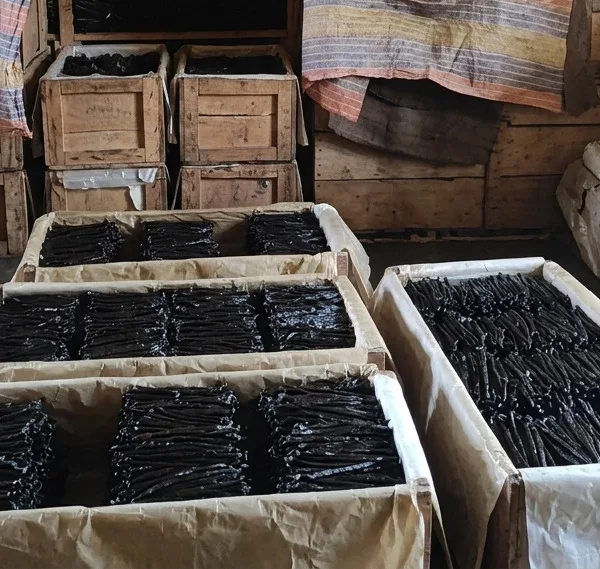
The wood breathes with the pods and stabilises the humidity inside the chest.
The craft that reveals
The art of maturation
The terroir gives the material. Maturation releases its depth, month after month, in the silence of rosewood. At harvest, the pod carries a promise, dense and closed, shaped by the vine, the soil, the light and the rain.
Preparation is followed by refining, the period of maturation when the material opens, the notes round out and the lot’s signature becomes clear. The wood welcomes the pod. The hand follows its evolution until its fragrance reaches its full expression.
The living cycle
From vine to chest
A pod carries the memory of its season. A flower pollinated in the morning gives a green fruit that ripens on the vine for 8 to 9 months, sometimes longer depending on the variety. Rain, shade, warmth and the vigour of the plant shape this first material.
Tahitensis follows its own calendar. Its capsule stays closed at full maturity, allowing the pod to remain on the vine longer and gain further density. In Planifolia, full maturity sometimes opens the pod lengthwise and reveals the seeds. Harvest follows the reading of these signs.
After harvest, scalding, sweating and drying transform the green pod into aromatic material and fix the aromas. The pod arrives with its structure, its richness in oils, its woody substance and its fragrance, which will guide the rest of the refining process.
Almost 18 months separate the morning of pollination from the end of refining, longer for some lots. This duration embraces the whole cycle, from fruit growth to rest in the chest. Each stage prepares the next, until the final reading allows the lot to enter a creation.
The casket of time
The Malagasy rosewood chest
The rosewood chest is the quiet heart of the maison. It welcomes the pods after preparation, sheltered from direct light. At ANTOKALY, they remain there for at least 7 months, each lot accompanied according to its material and its evolution.
Malagasy rosewood accompanies the pods in silence. It breathes with them, exchanges humidity with them and passes on a share of its own density. Little by little, a woody undertone becomes part of the signature.
This choice belongs to the Malagasy savoir-faire. The wood, the time and the vanilla find their balance in this enclosed, tuned space. The chest sets the container, time will do the rest.
Rosewood passes on a share of its own aromatic structure to the lot in maturation.
The wood grows in the same earth as the vine. It belongs to the Malagasy culture of vanilla.
The duration
Maturation, over time
Time in the chest is counted from the end of preparation. Within this second calendar, the material evolves through nuances: a nose that opens, a skin that becomes more even, a roundness that grows clearer, secondary notes that find their place. These markers describe a lot’s progression, at a pace specific to each variety and each terroir.
-
Month 0
Entry into the chest
The wood receives the pods
The profile stays closed, dominated by grassy and raw woody notes. The pod finds its place in the chest.
-
Month 3
First blendings
The oils bind, the skin softens
A roundness settles in, still discreet. The wood and the pod begin to find their balance.
-
Months 5 to 6
The signature opens
The pod gains in complexity
Each variety, each terroir unfolds its own aromatic depth. The lot names itself.
-
Months 7 to 8
The final accord
Length, diffusion, persistence
The four readings agree. Monitoring confirms the lot’s balance or accompanies further refining.
The craft
Evaluating a lot over time
Refining calls for a regular presence. The pods are monitored, aired, sorted, repositioned and smelled. The gesture remains discreet, precise, attentive to the actual material. The lot record takes shape through these visits, with what the hand, the eye, the nose and infusion reveal of its evolution.
Our work is to follow this progression and recognise the moment when each variety, Planifolia, Tahitensis or Pompona, reaches its full complexity and its own aromatic depth, in tune with its terroir.
Texture
The hand assesses suppleness, elasticity and firmness. A well-matured pod yields to pressure and returns with poise.
Tactile assessment
- Technique
- Pressure of the hand
- Reference
- Suppleness and elasticity
- Check
- Pod firmness
Sheen
Sheen, colour, skin regularity tell the state of progress of the lot and its inner balance.
Visual assessment
- Technique
- Observation on the rack
- Reference
- Sheen and colour
- Check
- Skin regularity
Length
Intensity, balance, the gradual appearance of secondary notes sharpen the aromatic direction of the lot.
Aromatic assessment
- Technique
- Olfactory approach
- Reference
- Intensity and balance
- Check
- Secondary notes
Aroma
Length, diffusion and presence in infusion confirm the real maturity of the lot.
Tasting assessment
- Technique
- Setting an infusion
- Reference
- Length and diffusion
- Check
- Confirmed maturity
On some long-matured pods, fine pale crystals settle as needles or bright points, sometimes along the folds. This frost is a natural crystallisation of vanillin. Frost appears after long maturation on pods containing more than 2.3 % vanillin. It speaks of concentrated material and is read alongside its suppleness, its fragrance and its presence in infusion.
At ANTOKALY, these pods bear the name marokintana. This expression extends the reading of the lot to the details that its surface reveals.
The lot is ready when these 4 readings agree. Only then does it leave the chest.
The result
Signatures that hold up in creation
A well-guided vanilla diffuses clearly and keeps its aromatic direction in the preparation. It can support a ganache, accompany a cream, carry through the cold of ice cream or sustain a long infusion. Its presence is read in its balance and length on the palate.
Refining clarifies the lot’s signature and prepares its encounter with the recipe. The material retains the singularity of its terroir, with an expression clear enough to nourish the work of a chef, a pastry chef or a chocolatier.
The chefs, pastry chefs and chocolatiers who work with our vanillas recognise this stability. It comes from the time we have agreed to take.
Let us talk about the aromatic signature you are looking for, for a menu, a recipe, a season.
START THE CONVERSATION
Frequently asked questions
Why respect the natural cycle of vanilla?
The natural cycle of vanilla links flowering, the growth of the pod, harvest at maturity, preparation and affinage. A pod carries the memory of its season: rain, shade, heat and the vigour of the vine compose a substance already singular.
What does maturation change?
Maturation makes the substance gain in depth and in complexity. The oils blend, the secondary notes appear, the length settles in. A well-matured vanilla keeps its aromatic direction through the preparation: it carries a ganache, accompanies a cream or crosses the cold of an ice cream.
How long does vanilla maturation last?
At ANTOKALY, 7 months at minimum in a rosewood chest, until the full aromatic expression of the lot. Close to 18 months separate the morning of pollination from the end of affinage, more for certain lots. The release is decided by sensory assessment: suppleness, sheen, the hold of the wood, intensity, length.