A precious spice, vanilla holds its rank in the most carefully made preparations of the kingdom. A January 1692 edict names it, fixes its price, designates the quays through which it reaches the realm and counts it by the unit. Around that text, the treatises of the reign, a royal privilege and an apothecary's leaflet map out the place it already occupies in the king's circle.
It enters through the chocolate door
Chocolate already has its man in France. By letters patent of 28 May 1659, David Chaillou, an officer of the queen, obtains for 29 years the right to make and to sell throughout the kingdom a certain composition called chocolate3. The privilege is renewed by royal ordinance in February 1666. His shop on rue de l'Arbre-Sec opens in 1671. Vanilla travels in the wake of that trade, an ingredient of a preparation that is winning the city.
Thirty-three years after Chaillou, the kingdom is looking for money to fund the War of the League of Augsburg. It looks for it in the new beverages spreading through the provinces. Coffee, tea and chocolate gain ground, wine recedes, and the excise duties resting on wine recede with it. From that treasury calculation comes a text dated at Versailles, registered by the Parlement on 26 February 1692, granting a single man the right to sell these beverages throughout the kingdom1.
The text opens on the king's name, « LOUIS, etc. ». Boucherat, chancellor and keeper of the seals, sets the seal to it. Louis XIV speaks there of these beverages « which most people judge useful to health ». The phrase is worth keeping, because it places vanilla on the side of the remedy at the very moment it becomes a watched article of trade.
LOUIS, etc. The beverages of coffee, tea, sorbet and chocolate have become so common in every province of our kingdom that our excise duties suffer a considerable diminution from them. Wishing nevertheless to leave our subjects the use of these beverages which most people judge useful to health, we have resolved to draw some relief from them in the occurrence of the present war, to make good the diminution our excise duties may hereafter receive.
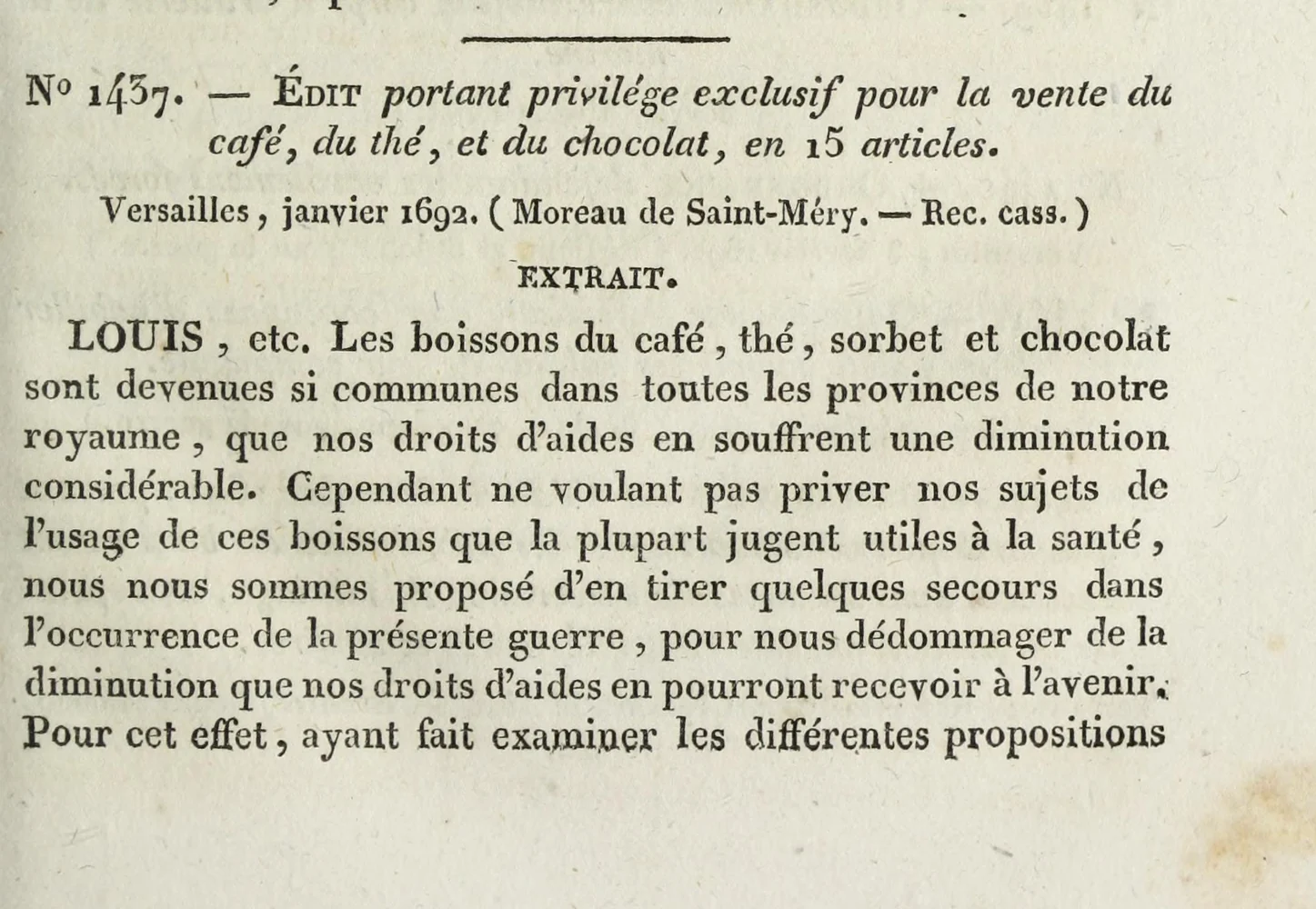
Vanilla appears in that text under the heading of chocolate, whose taste it composes. The act establishing François Damame, a burgher of Paris, in his privilege for six years from 1 January 1692 says so in its own words, the coffees, the teas, the sorbets, the chocolate « with the drugs of which it is composed, such as cacao and vanilla »2.
Drug means ingredient, in the vocabulary of the apothecaries of the day. Vanilla enters French law as a material that gives taste, beside cacao, inside a preparation.
Two quays for a whole kingdom
The text then closes the route. Entry overland falls under the ban. By sea, two ports stay open, Marseille for the Mediterranean, Rouen for the Atlantic. A pod that touches the kingdom anywhere else goes to confiscation. Whoever brought it in pays a fine of 1,000 livres.
Two quays hold the whole trade of a kingdom running from Bayonne to Lille. The measure says what vanilla is worth. A state at war devotes an article of law to watching it, sets its points of entry, puts a figure on the fine. That rarity is paid in distance as much as in money.
For the pod arriving at Rouen has already lived. It was pollinated in the forests of the Gulf of Mexico, picked at maturity, cured on the spot, dried in the shade, then tied. It crosses the Atlantic in a crate, passes through Iberian warehouses, changes owner at every stage. Time at sea is counted in weeks, the whole voyage in months. What the king's tax farmer puts on sale in Paris is an old material, carried by a climate France knows nothing of and by gestures it watches from afar.
Coffee is weighed, vanilla is counted
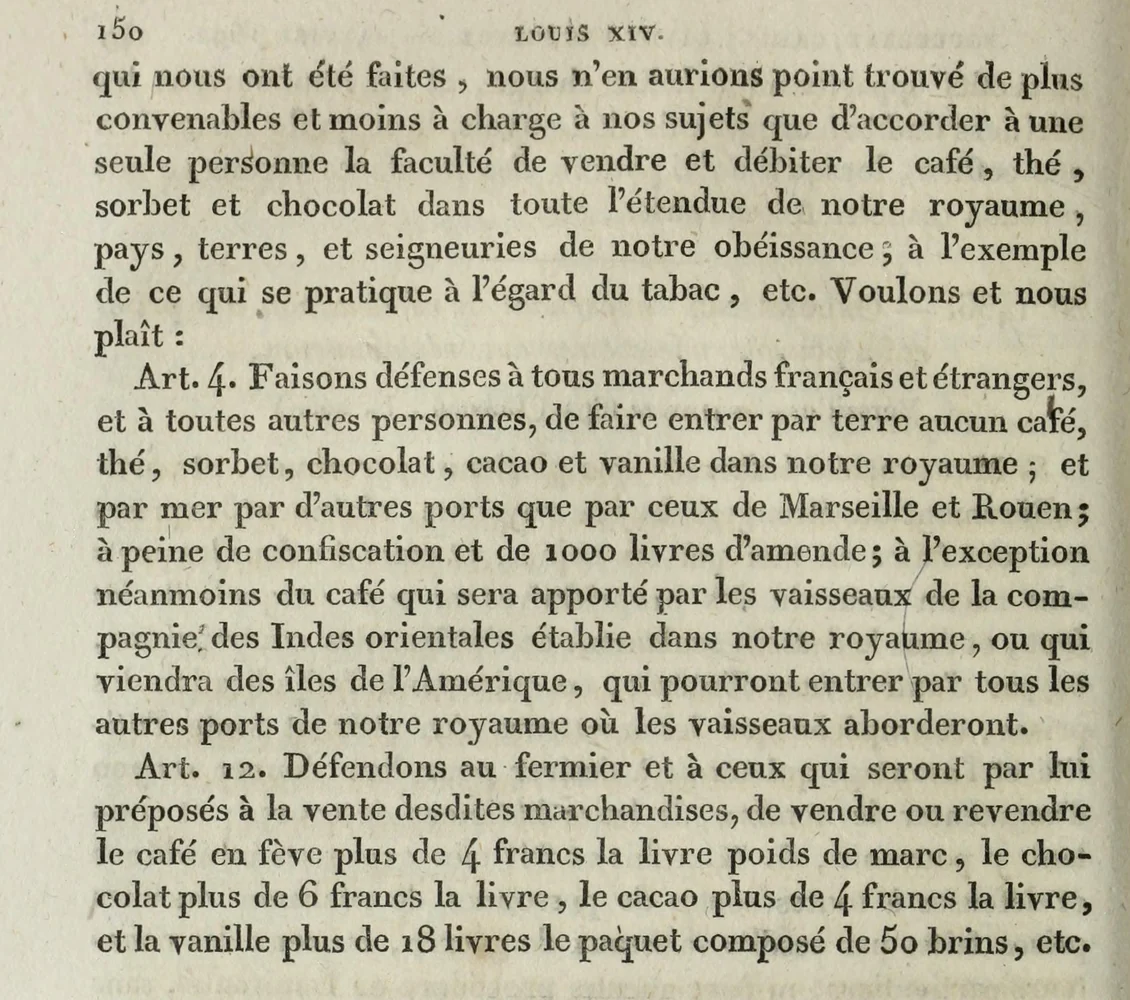
The same text caps selling prices. Coffee at 4 francs the pound, chocolate at 6 francs, cacao at 4 francs. Those three are weighed by the mark pound, worth about 489 grams. For vanilla, the drafter changes the measure.
and vanilla above 18 livres the bundle composed of 50 stems1
Here the livre becomes a currency, the livre tournois. The price bears on a physical object, tied and countable, a bundle of 50 stems. The drafter sets that number down and moves to the next article, which implies a measure already familiar to everyone who buys and sells.
Simple marker
Vanilla sells by the tied bundle of 50 stems, capped at 18 livres tournois. A country labourer puts 40 days of wages into it10, almost one per pod.
The druggist who receives it
Two years after the edict, Pierre Pomet, a grocer and druggist of the Paris trade, publishes his Histoire générale des drogues6. A whole chapter goes to vanilla. Pomet receives it, sorts it, sells it. He writes what he has in his hands.
He begins with the vine. A round stem set with nodes « like a sugar cane », broad thick leaves, a plant of twelve to fifteen feet that climbs along walls, at the foot of trees or on stakes. The pods come out green, turn yellowish, brown as they ripen. Then comes the gesture.
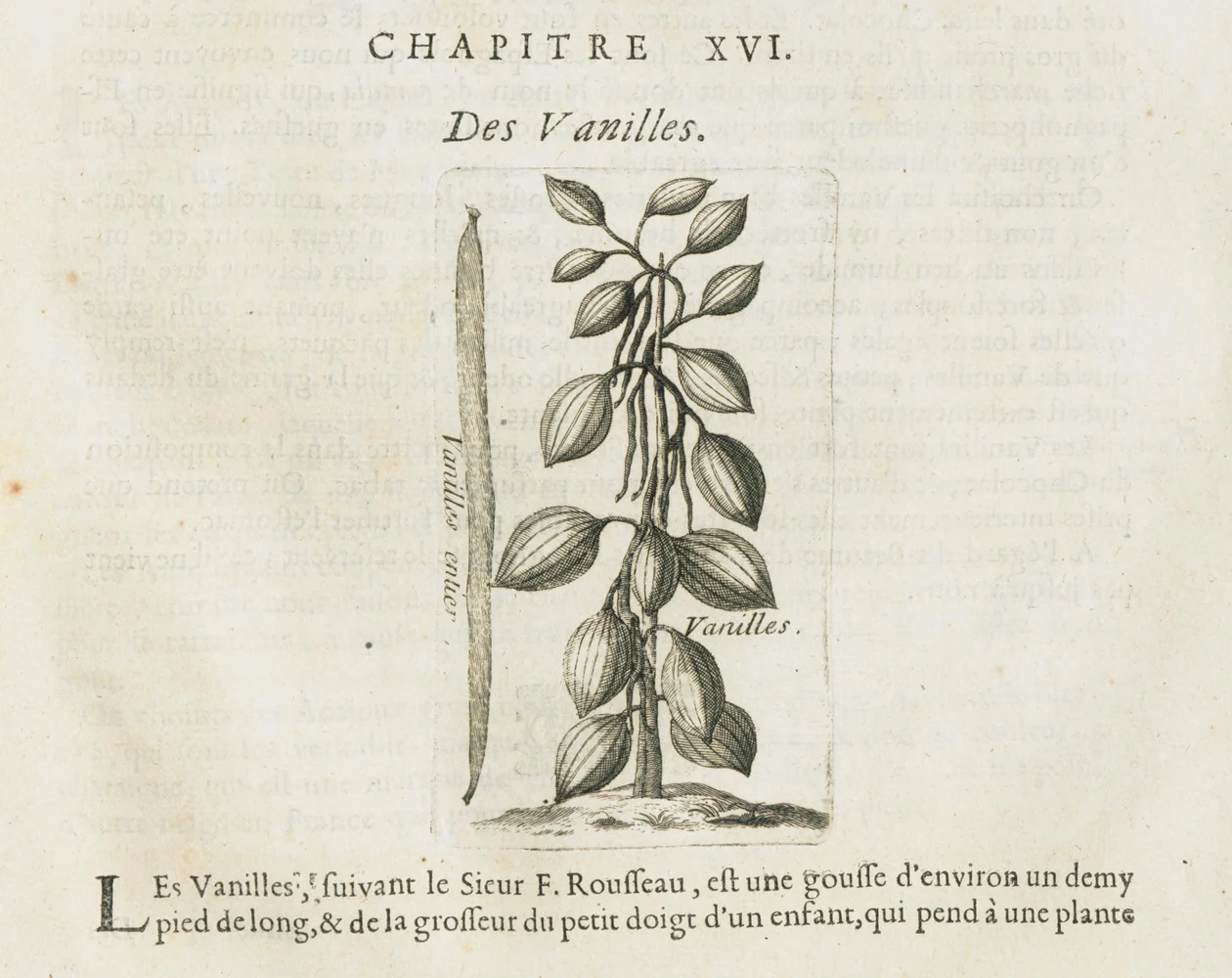
When they are ripe, the Mexicans, those of Guatemala and of Santo Domingo pick them, tie them by the ends, and set them in the shade to dry. When they are dry and fit to be kept, they rub them with oil, to keep them from drying too much and from breaking, and then they put them up in bundles of fifty, of a hundred, or of a hundred and fifty, to send them to us.
The bundle of 50 therefore comes from the harvest. The hand that ties the pods as they leave the drying makes the unit. That unit then travels to the quays of Rouen, to the counters of Paris, to the text of law that fixes its price. Versailles takes up a measure born in the drying sheds of the Gulf of Mexico.
Pomet then says how a pod is chosen.
Choose the vanillas well nourished, thick, long, new, weighty, unwrinkled, and unrubbed with balsam [...] to be good they must be fat and very supple, with a pleasant smell, taking care also that they be even [...] and that the seed within, which is extremely small, be black and shining.
Fat, supple, even, fragrant, with black and shining seed. These are the markers the hand still looks for today on a sorting table. Richness in oils, suppleness, the evenness of a lot, seed content, raw fragrance all sit inside that sentence from 1694. The trading criteria stand beside them, the thick and the weighty, which the house has long set aside.
That demand has its reason. Pomet moves on to the frauds. His description raises a shiver. Growers « more careful of gain than of conscience » let the pods « burst from their too great ripeness » on the vine, after setting small earthen cups beneath to collect a black and fragrant balsam that runs from them. The balsam goes to sale, and emptied pods remain. They slip in « little sticks, or other such things », sew them up again, put them in bundles, and these resewn pods arrive in Paris dry and of no effect. The bundle itself is made up, since its middle fills readily with small vanillas devoid of smell.
Reading a lot begins there. The hand opens the bundle, draws out the pods from the middle, looks for the seam. That gesture is 3 centuries old.
Pomet also gives the origin of the word. The Spanish named this merchandise vanilla, « which means in Spanish a little sheath, because these pods are made like sheaths ». He notes at last that vanilla serves in France in the composition of chocolate, that some use it to scent tobacco, and then that it is taken inwardly to strengthen the stomach.
Three pods for seven hundred cacaos
Seven years before the edict, a Lyon apothecary gives the recipe. Philippe Sylvestre Dufour publishes in 1685, with Jean Girin and Barthélemy Rivière, his Traitez nouveaux & curieux du café, du thé et du chocolate4. He takes up there the composition of chocolate after Barthélemy Marradon, with the doses.
Seven hundred cacaos. One pound and a half of sugar. [...] ounces of cinnamon. Fourteen grains of Mexican pepper, called chile or pimiento. Half an ounce of cloves. Three pods of vanilla, or in its place two ounces of anise. The bulk of a hazelnut of achiote.
Three pods for seven hundred cacaos. Vanilla holds its place in an assembly where cinnamon, clove and Mexican pepper each play their part. Dufour adds the variants in circulation, orange flower water, a grain of musk or of ambergris, almonds and hazelnuts, powder of Alexandria roses.
The most telling line remains the substitution. Two ounces of anise take the place of the 3 pods when they are wanting. Vanilla is then replaced by an aniseed note. The price of that equivalence says plainly enough what its rarity cost.
Further on, Dufour devotes a chapter to it alone. He opens it on a Nahuatl name borrowed from another plant, a slip told in where the name vanilla comes from.
Vanilla, which others call Mecaxuchil, is a pod of a very pleasant smell and of a sharp taste. It strengthens the stomach and the heart, it thins thick and viscous humours, and is an excellent remedy against venoms. Mixed with tobacco, it corrects the unpleasant smell of its smoke.
Tobacco thus returns in Dufour as in Pomet, 9 years apart. Two merchants who handle the material report the same use, which gives weight to that forgotten detail.
The treatises quarrel over its use
Vanilla occupies the best pens of the kingdom at that time. Nicolas de Blégny, surgeon to Queen Marie-Thérèse from 1678, physician to the king from 1682, publishes in 1687 Le bon usage du thé, du caffé et du chocolat5. Louis Lémery, physician at the Hôtel-Dieu and member of the Academy of Sciences, places chocolate among the foods in his Traité des aliments of 17028.
Pomet, in his chapter on chocolate, ranks vanilla among the things that make the best of it, « when it has been made with the large Caraque, and when fine sugar, good cinnamon, and fine and good vanillas have been used in it ». He adds that Paris makes the best chocolate in the world.
The same chapter settles his account with Blégny. Pomet holds for imaginary a « Fleur d'Orejevalla » that Blégny brings into his composition, he tells of questioning him face to face before a witness, then reports the embarrassed answer he received. The flower already figured in Dufour in 1685, among the ingredients some bring into chocolate. The three men read one another and contradicted one another. Vanilla was worth that quarrel.
The flask of the royal laboratory
From Blégny's book comes a more modest object. A laboratory of the Collège des quatre Nations prints a 4-page leaflet for its syrup of vanillas7, drawn from the 1687 book and probably edited by the apothecary Léonard Biet.
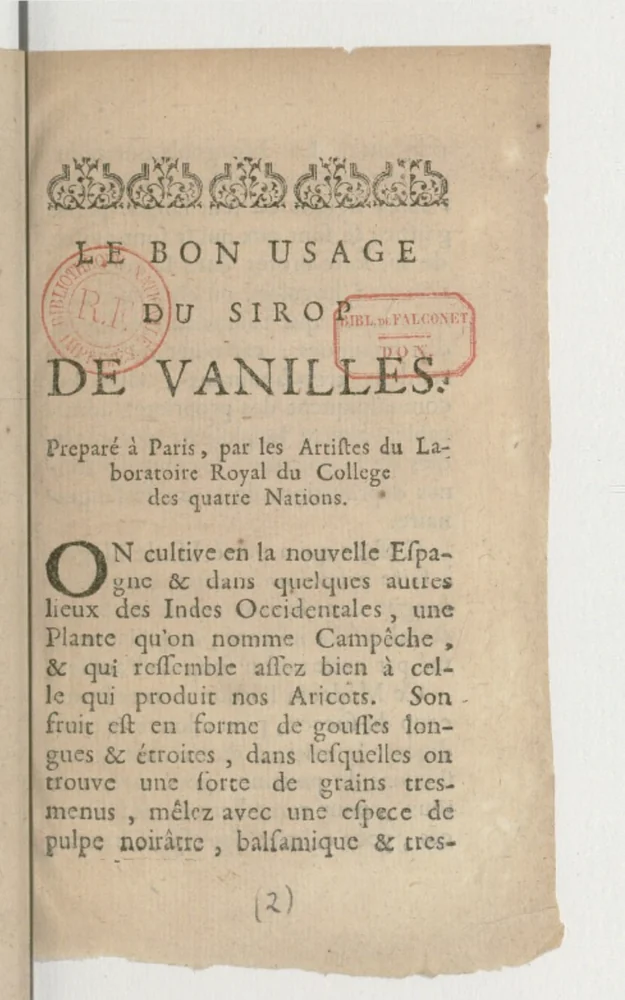
The text names the plant Campeche, after a port and a province of New Spain, likens it to the bean for its outline, as Pomet does, then details what the pod carries, a long narrow form, very fine seeds, a blackish balsamic pulp.
The syrup is taken by two or three spoonfuls. In continued and malignant fevers, the dose is diluted in four ounces of orange flower or balm water. In colds and chest catarrhs, it replaces sugar at the bottom of the cup of chocolate. The same laboratory sells alongside it a defatted chocolate prepared on the premises, which sketches a small dispensary where vanilla moves between preparations.
The syrup also says how vanilla was worked. It gives itself to liquid, it holds in sugar, it keeps in a bottle and is dosed by the spoon. A Paris apothecary thus kept on hand a vanilla ready for use, able to pass from a potion to a cup according to the hour of the day.
Then the last page widens everything. The syrup goes into tea, into coffee, into coffee milk, « that is to say into the tincture of coffee drawn with milk ». The author writes that its use may be made as familiar as that of the most common foods, including for a person in perfect health. The sentence marks a passage. Vanilla leaves the shelf of the remedy for the table. The argument that carries it there is pleasure.
The price closes the page, in italics. The bottle sells for forty sols.
It circulates thus at court, between the chocolate of the queen's officer and the flask of the royal laboratory, while the vine that bears it still breathes at the other end of the world.
The monopoly lasts sixteen months
The privilege of François Damame was to run until the end of 1697. A decree of the Council of State revokes it on 12 May 16932. Vanilla keeps its place in the list of watched merchandise. The kingdom now applies to it a duty levied at entry into the territory, calculated on each pound weight.
The measure crosses two centuries
On 1 November 1899, the Journal des confiseurs-glaciers explains to its readers how their vanilla reaches them. It is tied in bundles of about 50 pods9.
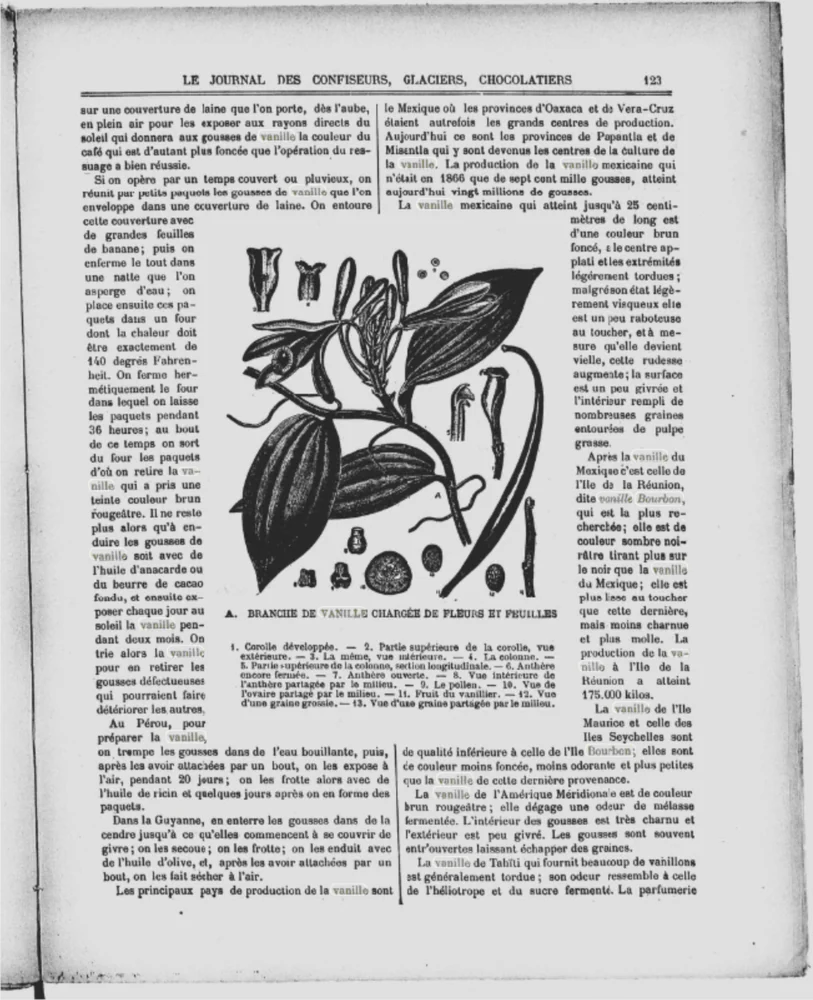
205 years after Pomet, the same bundle. Between the two, vanilla has crossed an ocean, changed ground, gained terroirs the edict knew nothing of. The measure holds because it comes from the hand, 50 stems make a bundle that is grasped, tied, turned over, counted at a glance. The bundling gesture at Antalaha finds that same count today.
The king's name passes to the pod
The vanilla Paris counts and taxes grows in America at that time. Pomet names three origins, Mexico, Guatemala, Santo Domingo. The journey to the Indian Ocean, the European glasshouse from which the cultivated Planifolia descends, the arrival at Bourbon and then at Madagascar around 1870 belong to a separate account, told in the origin of vanilla, from Mexico to Madagascar.
One thing plays out here, though. The island that receives those cuttings bears the name of the reigning house, Bourbon. The vanilla that grows there will take that name in turn, then carry it to Madagascar and onto the labels of today. The reign that counts it by 50 in 1692 thus leaves it its appellation, by way of an island and a dynasty.
Madagascar already carried its own Vanilla, several indigenous species spread from the rocks of the north to the spiny thickets of the south. They belong to the natural history of the island and long precede it.
What the bundle of 50 shows
The texts of the reign show a vanilla already held as precious, watched at the port, capped in price, counted stem by stem, counterfeited by those who find their gain in it. It is worth something then for its rarity and for the taste it gives to chocolate.
The 3 centuries that followed gave it lands, climates, hands and a long time of maturation. Its rarity moves then towards what a terroir lays down in a pod, a legible signature belonging to one slope, one season, one way of tending.
The gesture passes on intact. Pomet wrote that good vanillas are known to be fat, supple, even, with black and shining seed. The hand that opens a bundle at Antalaha looks for exactly that.
Madagascar carries terroirs the world is only beginning to discover. We open them lot after lot.
To follow the rest of the journey, discover our craft, explore our varieties and terroirs, or let us talk about your project.
Professional reference
Connect the reference to the actual material: touch, scent, infusion and intended use together form a complete reading.
Frequently asked questions
Was vanilla known at the court of Louis XIV?
Yes. A January 1692 edict issued in the king's name lists vanilla among the goods whose sale is placed under privilege, alongside coffee, tea, sorbet, chocolate and cacao. Chocolate itself had been under a privilege granted in 1659 to David Chaillou, an officer of the queen. Nicolas de Blegny, surgeon to Queen Marie-Therese and later physician to the king, published a work on the proper use of chocolate in 1687, and a Paris royal laboratory sold a syrup of vanillas at forty sols the bottle.
What was the price of vanilla in 1692?
Article 12 of the edict of January 1692 forbids selling vanilla above 18 livres the bundle composed of 50 stems. The livre here is a currency, the livre tournois. Coffee, chocolate and cacao sold by weight, while vanilla sold by the bundle.
Where does the bundle of 50 pods come from?
From the growing places. The Paris druggist Pierre Pomet writes in 1694 that the pods are picked at maturity, tied by the ends, dried in the shade, rubbed with oil, then put up in bundles of fifty, of a hundred or of a hundred and fifty for shipping. The Journal des confiseurs-glaciers still describes bundles of about 50 pods in 1899.
How was good vanilla recognised in the 17th century?
Pomet writes in 1694 that a good vanilla is known to be fat and very supple, of a pleasant smell, even within the bundle, with an inner seed that is black and shining. He warns against pods emptied of their balsam and sewn up again, and against bundles whose middle is filled with small pods devoid of smell.
Sources
- Isambert, Jourdan and Decrusy (1821). Recueil général des anciennes lois françaises, vol. 20, Paris, Belin-Le-Prieur, pp. 149-150, extract of the edict of January 1692. Original printing, Paris, E. Michallet, 1692, BnF, shelfmark F-23615 (3). archive.org
- Champollion-Figeac A. (1848). Documents historiques inédits, vol. 4, Paris, Firmin Didot, pp. 684-685, privilege of François Damame and revocation of 12 May 1693. gallica.bnf.fr
- Letters patent of 28 May 1659 granting David Chaillou the chocolate privilege for 29 years, renewed by royal ordinance of 5 February 1666. An act known through secondary literature, including Harwich N. (1992). Histoire du chocolat, Paris, Desjonquères. The original text is still to be located, and Isambert's Recueil général des anciennes lois françaises, vol. 17, covering 1643 to 1661, passes over it in silence.
- Dufour P.S. (1685). Traitez nouveaux & curieux du café, du thé et du chocolate, Lyon, Jean Girin and Barthélemy Rivière. archive.org
- Blégny N. de (1687). Le bon usage du thé, du caffé et du chocolat pour la préservation & pour la guérison des maladies. gallica.bnf.fr
- Pomet P. (1694). Histoire générale des drogues, Paris, Jean-Baptiste Loyson and Estienne Ducastin, Book VII, chaps. XV and XVI, pp. 206-208. archive.org
- Le bon usage du sirop de vanilles. Préparé à Paris, par les Artistes du Laboratoire Royal du Collège des quatre Nations, Paris, between 1687 and 1700, BnF, shelfmark 8-TC24-51. gallica.bnf.fr
- Lémery L. (1702). Traité des aliments, Paris, J.-B. Cusson and P. Witte.
- Journal des confiseurs-glaciers, 1 November 1899, p. 123. gallica.bnf.fr
- Vauban S. Le Prestre de (1707). Projet d'une dixme royale, pp. 97-98. The country labourer is estimated there at 9 sols a day, with the note that most earn 8 sols. archive.org