Madagascar supplies the world with vanillas that came from the Americas. The island carries its own as well. Nine indigenous species, seven leafless vines cut back by drought, two leafy vines from the forests of the east and the south-west. Nine species recorded to date. Two of them joined the list in 20232. On an island where botany still names plants nobody had described the year before, that number has every chance of growing.
Seven leafless vanillas
The wild vanillas of Madagascar are climbing orchids of the genus Vanilla, present on the island long before any cultivation. Seven of them have lost their leaves. They grow on the rocks of the north, the sandy soils of the west, the spiny thickets of the deep south.
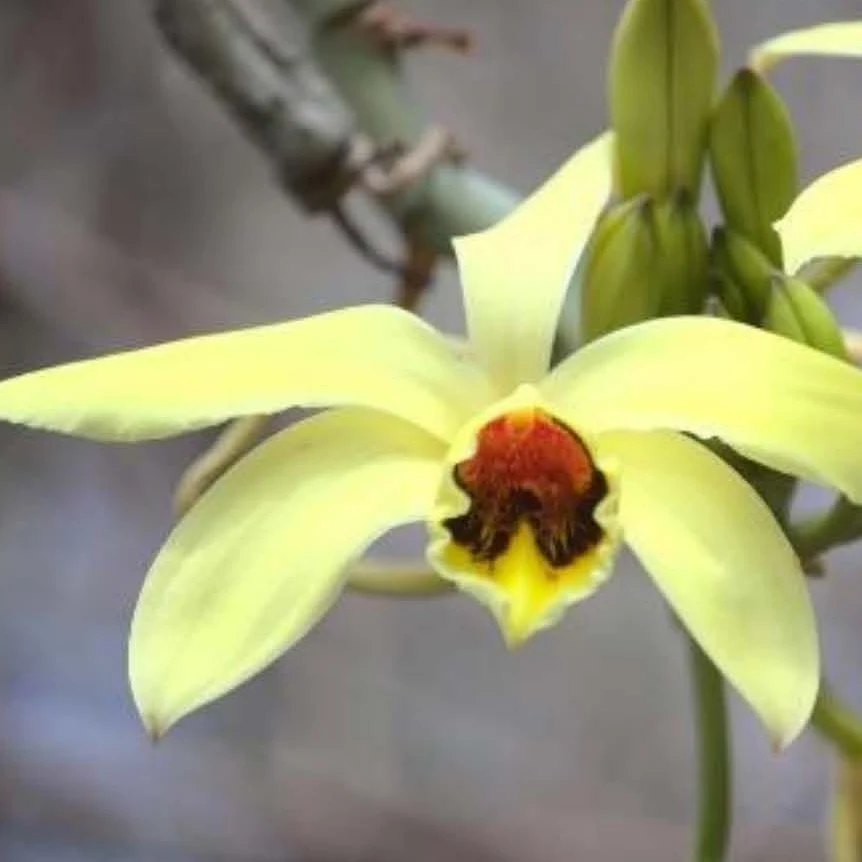
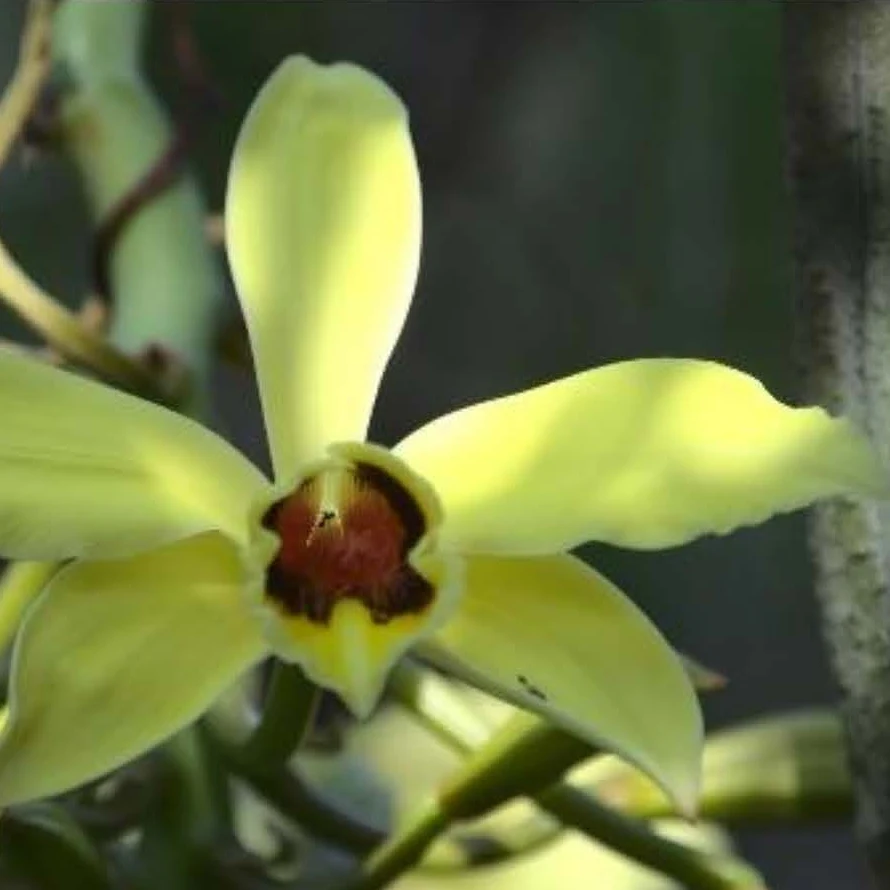
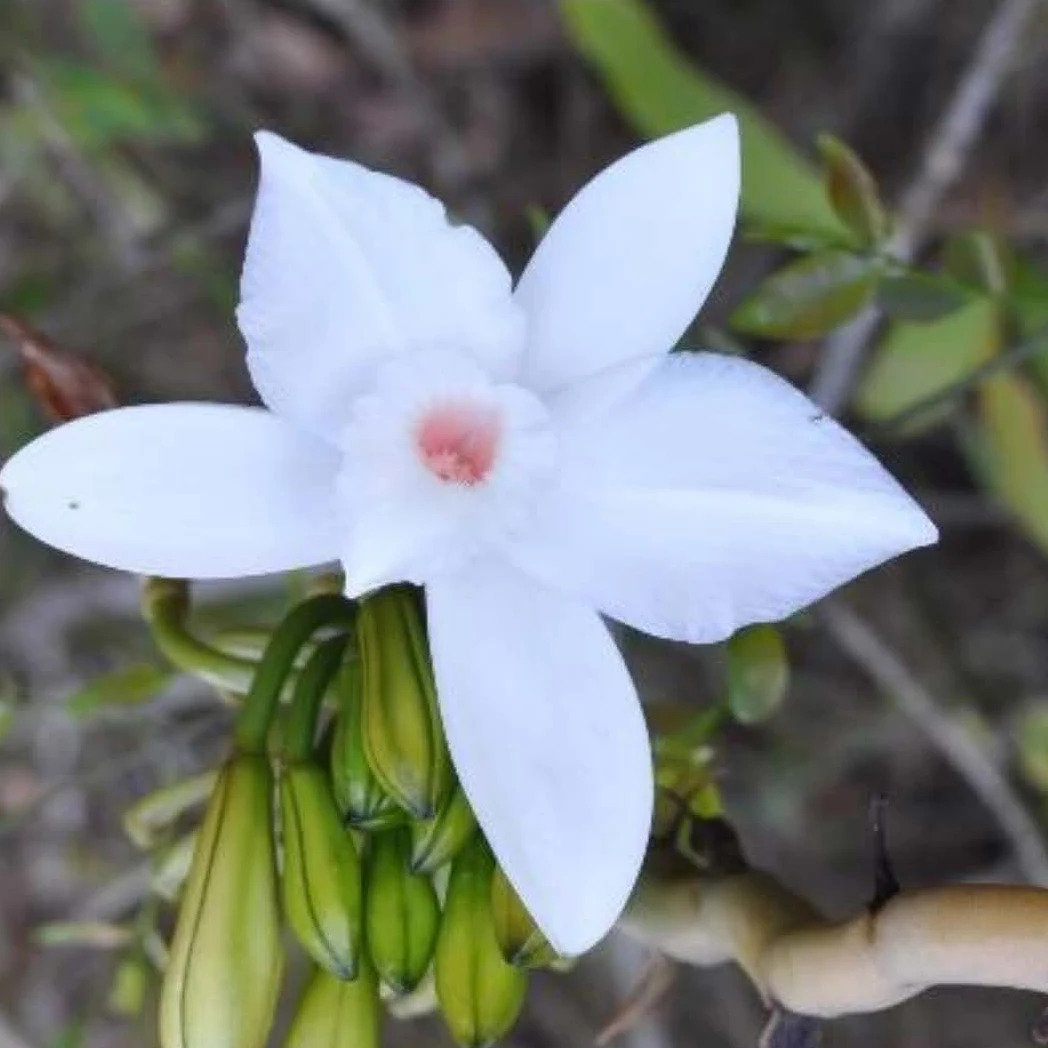
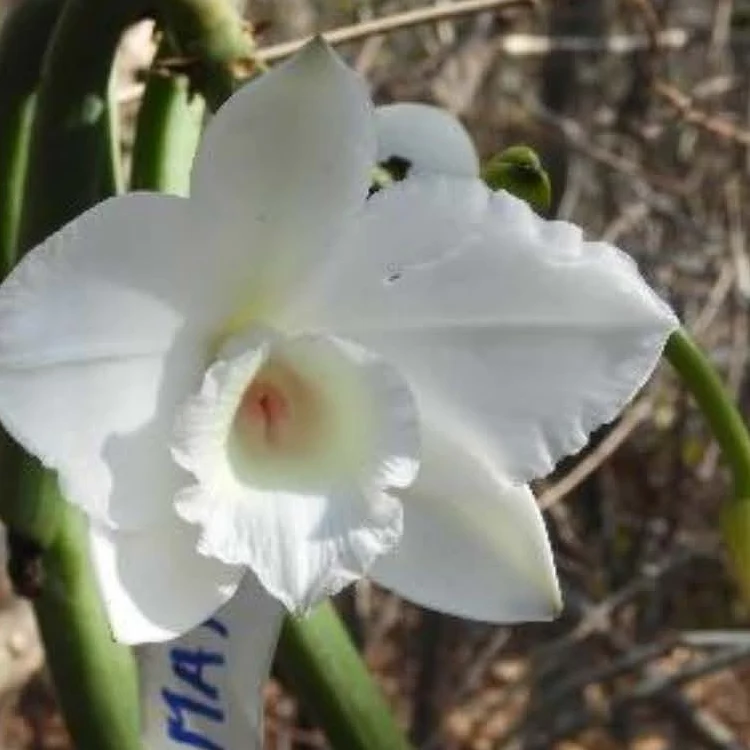
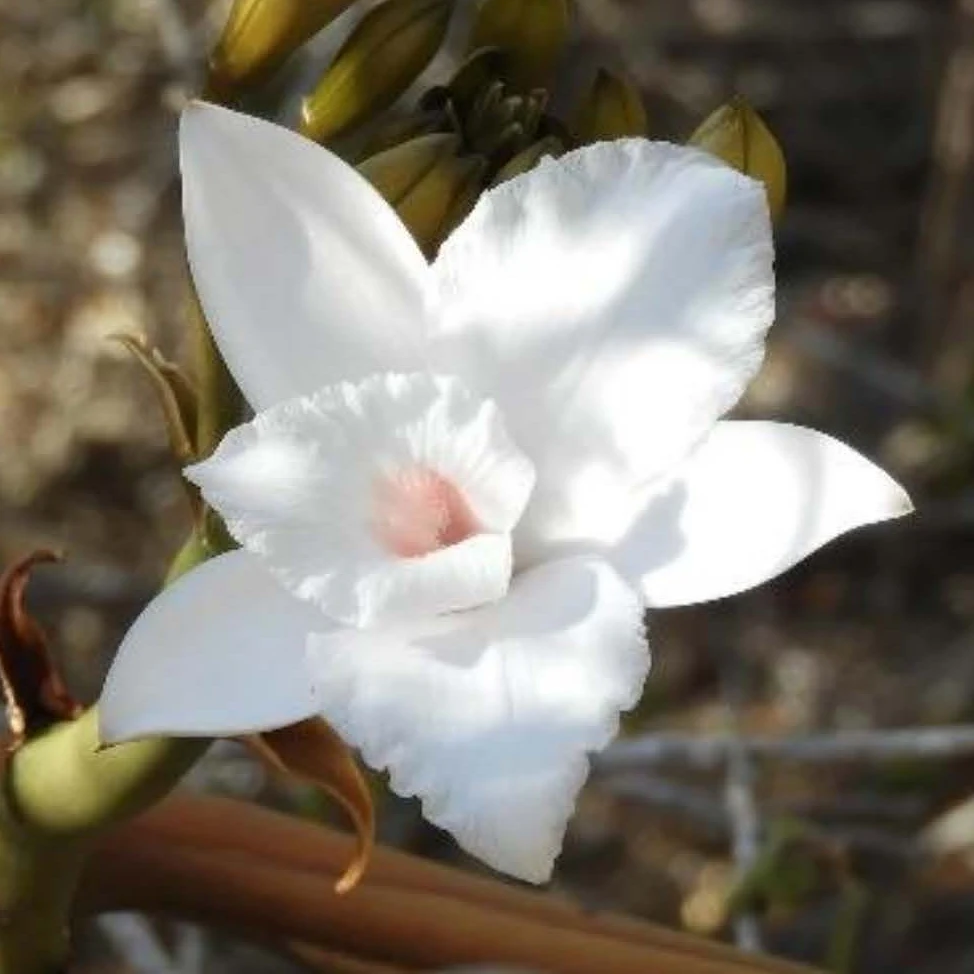
Photographs by Johnson G. Andrianantenaina, Alemao Botomanga and Cathucia F. Andriamihaja, published in Andriamihaja et al. 2020, CC BY 4.0, cropped. Vanilla allorgeae and Vanilla atsinananensis, described in 2023, are still awaiting a freely licensed image.
The seven leafless species
| Species | Flower | Where it grows | Flowering |
|---|---|---|---|
| V. madagascariensis | White, red throat | Dry forests of the west coast, humid forests of the north-east, SAVA, Diana, Ankarana, Isalo, Ivohibe | June to October |
| V. perrieri | Bright yellow, red throat | Ankarafantsika, west coast, from Majunga to Ambovombe | November to December |
| V. bosseri | White, pink throat | South-west, Namoroka reserve, Morondava region | September to November |
| V. decaryana | White, pink throat | Dry thickets of the south, among the Didiereaceae, Andohahela | January |
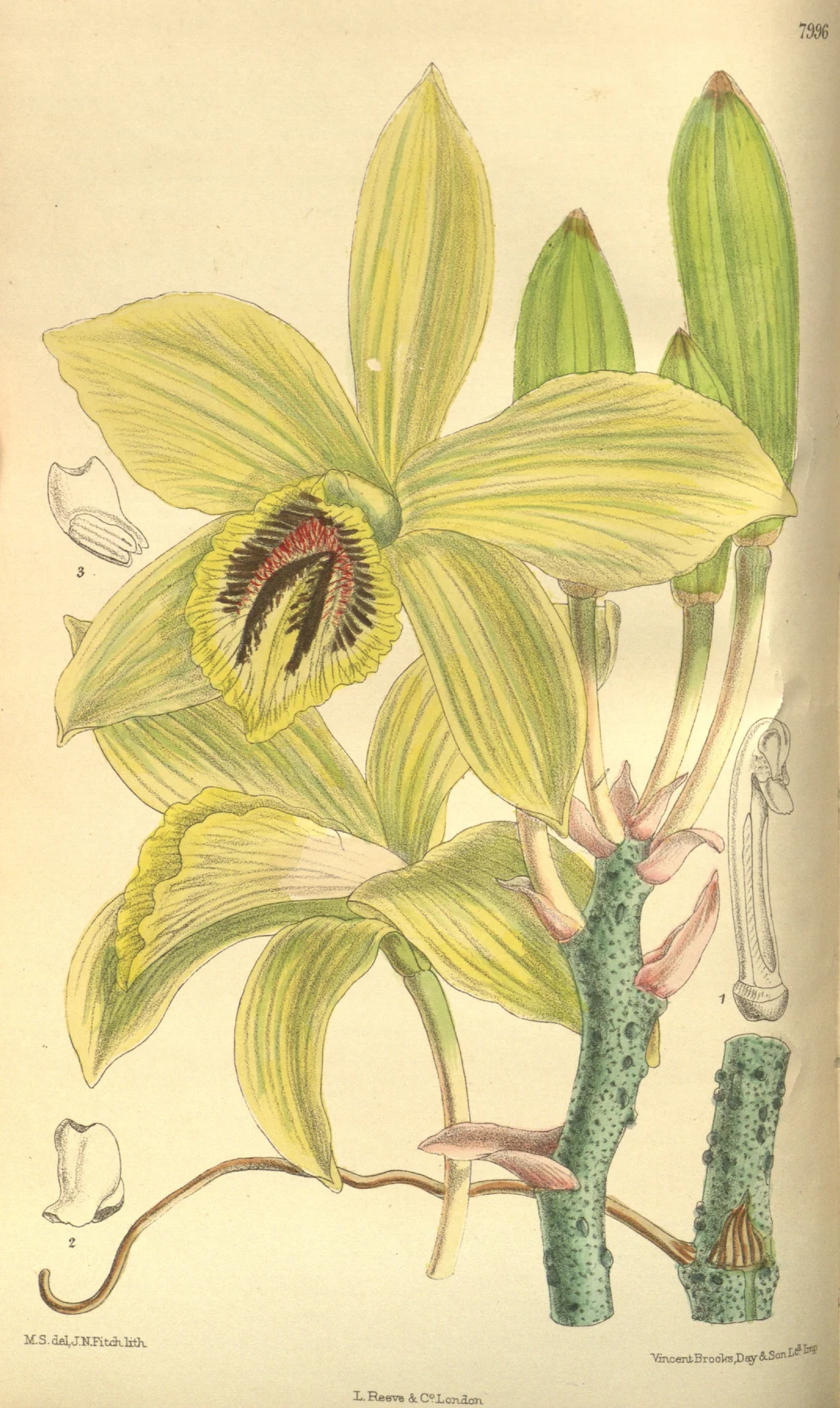
| V. humblotii | Canary yellow, velvety dark red throat | Rocks of the north, Montagne des Français, Ankarana, Bemaraha, also the Comoros and Mayotte | November to April |
| V. allorgeae | Described in 2023 | Eastern side of the island, central highlands | Not documented |
| V. atsinananensis | Described in 2023 | Eastern side of the island, low-lying coastal belt | Not documented |
The last two joined the list in 2023, at the end of a study combining morphology, microsatellite markers and sequencing, carried out by a Malagasy and Réunion team. The name of the second comes from the Malagasy atsinanana, the east.
Two leafy vanillas
Two Malagasy species kept their leaves6. These are the ones that most resemble the vanilla of the plots.
The two leafy species
| Species | Described in | Where it grows | Habit |
|---|---|---|---|
| V. francoisii | 1939 | North-east Madagascar, humid forests | Leafy vine |
| V. coursii | 1950 | South-west Madagascar, seasonally dry forests | Leafy vine, blade 10 to 16 cm |
The resemblance stops at the silhouette. Vanilla coursii carries the name of Gilbert Cours, who collected it in 1950 on the hill of La Table, twenty-five kilometres north of Antalaha8. That herbarium sheet rests in Paris today. For a long time it stood as the only proof of the species: the major revision of the genus published in 2010 reports that its authors could gather no study material. Twenty-first century surveys have found it four times over, from the forest of Kalabenono near Ambilobe to Menagisy near Toamasina.
Why these vanillas have no leaves
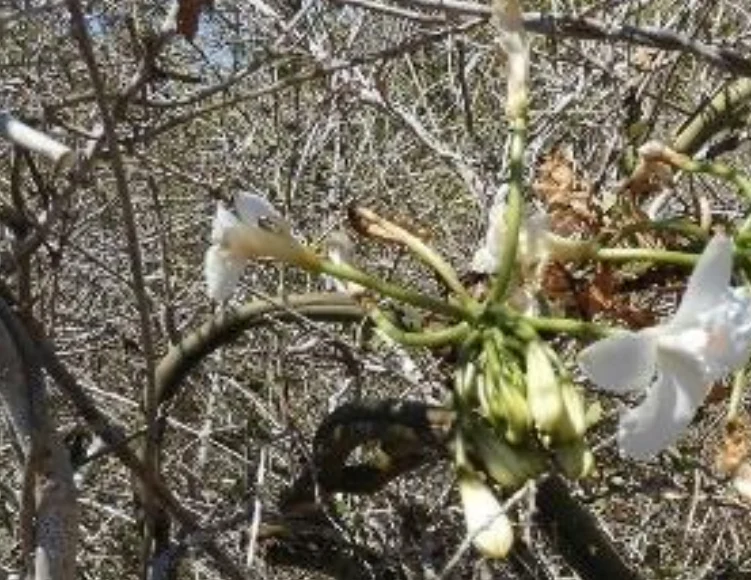
Drought shaped this form. The seven leafless species carry green, thick stems, reduced to scales where a Planifolia unfurls its leaves. The group is the only one in the genus Vanilla to hold hot, dry habitats in full sun.
The remarkable part lies in the repetition. Leaflessness appeared at least three times independently among the vanillas, in Africa, in Asia and in America, each time as an answer to the same constraint1. Three separate lineages found the same solution.
A simple marker
A leaf costs water. These vanillas replace it with a green stem that works in its place.
A lineage born on the island
The leafless vanilla group formed in Madagascar, then spread to the Comoros, the Seychelles and the East African coast. The island is the starting point, the centre of diversity, the matrix of the group.
This lineage is still young. The species resemble one another, sometimes live side by side on the same sites, and separate on details of labellum and stem. The authors of the reference review speak of a taxonomic puzzle1. Five species were recognised not long ago, seven today.
The bees of Kirindy
Three indigenous bees pollinate Vanilla bosseri in the forest of Kirindy, near Morondava: Macrogalea ellioti, Liotrigona madecassa and Liotrigona mahafalya3. The two Liotrigona are meliponines, stingless bees, which the review names as the most likely pollinators.
The flowers open in succession and last a single day. One inflorescence opens up to three a day in the white-flowered species, usually one in humblotii. For the latter, two visitors are retained, the bee Allodape obscuripennis and a bird, the sunbird Nectarinia coquerellii.
Insects from four orders have been observed on bosseri flowers, along with a lemur, Verreaux's sifaka. Only three bees were actually carrying pollen.
Fruit set remains an event. In Vanilla bosseri, the measured natural fruit set reaches 3.96%. In Vanilla humblotii on Mayotte, it falls between 0.62 and 1.2%. The author of the bosseri study offers a hypothesis that lights up these figures: some visitors would take the pollen without carrying it.
On our plots, a hand passes every morning throughout the season. Hand pollination brings the regularity a harvest asks for.
Another branch of the genus
Every vanilla gives pods. The genus Vanilla is defined by its fleshy fruit, an elongated capsule that common usage calls a pod. The nine Malagasy species produce them like the rest. The fragrance belongs to a single branch.
The vanillas with aromatic fruit all fall within the subgenus Xanata, section Xanata. That is where Planifolia, Tahitensis and Pompona are found, the three varieties we work with, along with the thirty or so fragrant species recorded to date.
The palaeotropical vanillas follow the other path, section Tethya, leafy and leafless alike. Their pods ripen in the forest, green then brown, before splitting open for the seed. The count of fragrant species has moved over time: six for Rolfe in 1896, eighteen for Portères in 1954, thirty-five in 20107.
What science has yet to learn
The aroma of these nine vanillas is still to be measured. No published analysis covers their pods, the vanillin, or the compounds that travel with it. The only palaeotropical relatives taken into a laboratory, two African species, come back with no vanillin potential5. For the Malagasy ones the question stands whole. It awaits the first laboratory that opens these pods.
Their cultivation is just as open a matter. These vanillas flower for a handful of bees and fruit by exception. Malagasy knowledge settled on their stems instead.
What they hold in reserve
Endurance in dry ground, first, proven in the spiny forests of the south.
Endurance against fusarium wilt next. Inoculation trials showed that Vanilla madagascariensis and Vanilla humblotii, together with V. phalaenopsis from the Seychelles, V. roscheri from East Africa and V. aphylla from Asia, resist or react weakly to Fusarium oxysporum f.sp. radicis-vanillae, the disease that weighs most heavily on Planifolia plantations4. The Antalaha vanilla station has been working on that resistance since 1944, crossing the cultivated vine with other species of the genus.
In a warming climate, this genetic heritage gains value every year.
Stems on the markets of the south
Traditional Malagasy use centres on the stem. Vanilla decaryana is used in the south for its aphrodisiac properties, Vanilla madagascariensis in the towns of the island for everyday medicine. The knowledge belongs above all to the southern communities, who use them as a tonic, as well as in care after childbirth and care for the child.
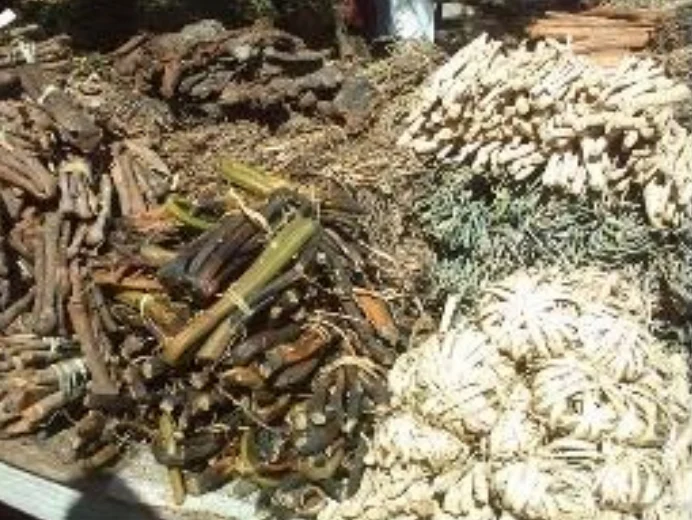
This demand leaves a mark. The most accessible populations of madagascariensis are subject to sustained harvesting. On Mayotte, Vanilla humblotii holds on across nine populations spread over less than twenty square kilometres, listed as vulnerable, protected by prefectoral order since 20181.
A neighbour in the SAVA
Vanilla madagascariensis is the most widely spread of the nine. Its range covers the dry forests of the west as well as the humid forests of the north-east. The SAVA is among the regions where it has been recorded.
This is the Antalaha region. The region of our plots, our lots, our maturation. A wild vanilla has grown there since long before a cutting from Mexico found its terroir, it flowers from June to October for a handful of bees, it gives its pods to the forest.
Madagascar was a vanilla land before it became the first producer.
For the vanilla we work with, explore our varieties and terroirs or discover our savoir-faire.
Professional reference
Connect the reference to the actual material: touch, scent, infusion and intended use together form a complete reading.
Frequently asked questions
What is a wild vanilla?
A wild vanilla is a species of the genus Vanilla that grows on its own in the forest, fertilised by the insects of the place. Madagascar carries nine of them, present on the island before any cultivation. Commercial vanilla comes from varieties that were planted and then pollinated by hand.
How many wild vanilla species does Madagascar have?
Madagascar carries nine indigenous vanilla species. Seven are aphyllous, that is leafless: Vanilla madagascariensis, V. perrieri, V. bosseri, V. decaryana, V. humblotii, along with V. allorgeae and V. atsinananensis, described in 2023. Two species keep their leaves, V. francoisii and V. coursii.
Are the wild vanillas of Madagascar fragrant?
No published analysis covers the aroma of their pods. The vanillas with aromatic fruit all fall within the subgenus Xanata, section Xanata, where Planifolia, Tahitensis and Pompona are found, while the Malagasy species belong to section Tethya. The only palaeotropical relatives measured in a laboratory come back with no vanillin potential. Botany therefore places these vanillas far from the known aromatic species. The chemistry of their pods still holds its answer.
Do the wild vanillas of Madagascar produce pods?
Yes. The genus Vanilla is defined by its fleshy fruit, an elongated capsule that common usage calls a pod. The nine Malagasy species flower, are visited by indigenous bees and set fruit, even though natural fruit set stays low. Their pods ripen in the forest, then split open to release the seed.
Can you buy wild vanilla from Madagascar?
The nine indigenous species are neither cultivated nor harvested for their pods. Madagascar vanilla comes from introduced and then cultivated varieties, Planifolia, Tahitensis and Pompona, pollinated by hand. On the markets of the south of the island, it is the stems of the wild vanillas that are sold, for traditional medicine.
Which insects pollinate the wild vanillas of Madagascar?
Three indigenous bees were found carrying the pollen of Vanilla bosseri in the forest of Kirindy: Macrogalea ellioti, Liotrigona madecassa and Liotrigona mahafalya. For Vanilla humblotii, the bee Allodape obscuripennis and the sunbird Nectarinia coquerellii are retained as potential pollinators. Natural fruit set stays low, measured at 3.96% in bosseri.
Why do these vanillas have no leaves?
Leaflessness is an adaptation to drought. The green stem carries out photosynthesis in place of the foliage, which lets these vines hold on in spiny thickets and dry forests. The trait appeared at least three times independently in the genus Vanilla, in Africa, in Asia and in America.
Sources
- Andriamihaja C.F., Ramarosandratana A.V., Grisoni M., Jeannoda V., Besse P. (2020). The Leafless Vanilla Species-Complex from the South-West Indian Ocean Region: A Taxonomic Puzzle and a Model for Orchid Evolution and Conservation Research. Diversity 12(12), 443. doi.org/10.3390/d12120443
- Andriamihaja C.F., Ramarosandratana A.V., Zc. Ranaivoson S.E.F., Grisoni M., Jeannoda V., Besse P., Pailler T. (2023). Integrative taxonomy and phylogeny of leafless Vanilla orchids from the South-West Indian Ocean region reveal two new Malagasy species. Journal of Systematics and Evolution 61(1), 80-98. doi.org/10.1111/jse.12858
- Petersson L. (2015). Pollination Biology of the Endemic Orchid Vanilla bosseri in Madagascar. Master's thesis, Uppsala University.
- Koyyappurath S., Conéjéro G., Dijoux J.B. et al. (2015). Differential responses of Vanilla accessions to root rot and colonization by Fusarium oxysporum f. sp. radicis-vanillae. Frontiers in Plant Science 6, 1125. doi.org/10.3389/fpls.2015.01125
- Brunschwig C. et al. (2021). Quantification of the aromatic potential of ripe fruit of Vanilla planifolia (Orchidaceae) and several of its closely and distantly related species and hybrids. European Food Research and Technology 247. doi.org/10.1007/s00217-021-03726-w
- Royal Botanic Gardens, Kew. Plants of the World Online, entries for Vanilla coursii and Vanilla francoisii. powo.science.kew.org
- Soto Arenas M.A., Cribb P. (2010). A new infrageneric classification and synopsis of the genus Vanilla Plum. ex Mill. (Orchidaceae: Vanillinae). Lankesteriana 9(3), 355-398.
- Muséum national d'histoire naturelle, Paris. Herbarium P, Vanilla coursii sheets P00102667, P00102668 and P00102669, collected by G. Cours no. 6, La Table, 25 km north of Antalaha, 1950. Later field records consulted through the Global Biodiversity Information Facility. gbif.org
Photographic credits. The field images come from Andriamihaja C.F., Ramarosandratana A.V., Grisoni M., Jeannoda V., Besse P. (2020), Diversity 12(12), 443, published under a Creative Commons Attribution 4.0 licence. They have been cropped for this page. The botanical plate of Vanilla humblotii, drawn by Matilda Smith and lithographed by J. N. Fitch, appeared in Curtis's Botanical Magazine vol. 131, plate 7996, in 1905. It is in the public domain.