The vanilla of the SAVA descends from a very small number of plants brought in during the 19th century, multiplied from cutting to cutting until it covered the region. One single vine, repeated for a century. When Fusarium wilt reaches the soils of Antalaha in the 1940s, that single plant offers the fungus one and the same hold. The answer stands on the hills of Ambohitsara, a few kilometres from our plots: a station where vanillas from several countries are brought together, crossed, then waited upon. 34 hybridisations come out of it, of which 23 still grow today.
An island planted with a single vine
Vanilla is grown from cuttings. A section of vine carrying a few nodes is taken, laid at the foot of a living support tree, it puts out roots and becomes a whole vine again. The method is simple, it calls for 3 to 4 years before the first flowering, it assures the grower that the new plot will give what the old one gave. Each cutting carries forward the inheritance of the plant it came from.
A plantation is read by these support trees. The vine climbs a living trunk, it is brought back down in a loop so it stays at hand height, it sets off upward again the following season. Around it grow the clove tree, the banana, the cinnamon tree, the coffee tree. Agroforestry holds the plot in shade and vanilla holds its place within that canopy.
Repeated from plantation to plantation for a century, the gesture of the cutting covers the region with a vanilla identical to itself from one hill to the next. The arrival of the vine in Madagascar rests on a few plants. Everything that grows afterwards descends from them. The grower gains the regularity of the harvest, the same robe, the same calibre, the same conduct in the field from one season to the next.
That regularity has a reverse side which the soil takes upon itself to reveal. A plant identical everywhere offers everywhere the same defence. What reaches one vine reaches its neighbour, since they are the same vine.
What the soil carries off
Fusarium wilt comes from a fungus that lives in the earth. It enters through the roots, reaches the tissues that carry the sap, the vine empties from the top. The leaves yellow, the stem browns at the base, the plant comes away from its support. On an affected plot, the disease moves from one plant to the next through the soil.
The fungus remains in the earth after the vine dies. Replanting in the same place amounts to offering a fresh cutting to a soil that already knows it. Growers then move the crop, open a plot further away, leave the previous one to the canopy. The disease joins them there. In the 1940s, the plantations of Antalaha rot on their supports in this way, season after season. The region watches its main crop withdraw of its own accord.
Vanilla is at that time the island's second agricultural export. These soils carry far more than a plot.
Faced with a soil pathogen, the path that holds over time runs through the plant itself. A vine that takes the blow is needed. It is found among the wild species of the genus, those that have always grown in contact with these fungi. They still have to be brought into cultivated vanilla.
The beautiful hills
The trials begin in 1944. Experimental plots are chosen, the plants that hold while the others go down are observed, notes are taken. In 1952, the work receives a site of its own, at Ambohitsara, a few kilometres from Antalaha. The Malagasy name says the beautiful hills. The vanilla station is founded5.
Raymond Théodose and Jean Dequaire carry its beginnings. The administration is colonial, the publications of the period carry French names. Dequaire will sign the synthesis of this programme in 1976, which remains one of the reference texts on Malagasy hybridisations2. The station then passes to the IRAT, the French institute for tropical agronomic research, then to the FOFIFA, the Malagasy national centre for applied research on rural development. It is Malagasy today, it remains in activity, on the same ground since 1952.
A hand-painted sign marks the entrance. Behind the trees, the collection stands on its supports, row after row. A vanilla station looks like an ordinary plantation to whoever passes by. It differs in what each row carries: vines brought from elsewhere, descendants of crosses, lines followed for decades on the same square of earth.
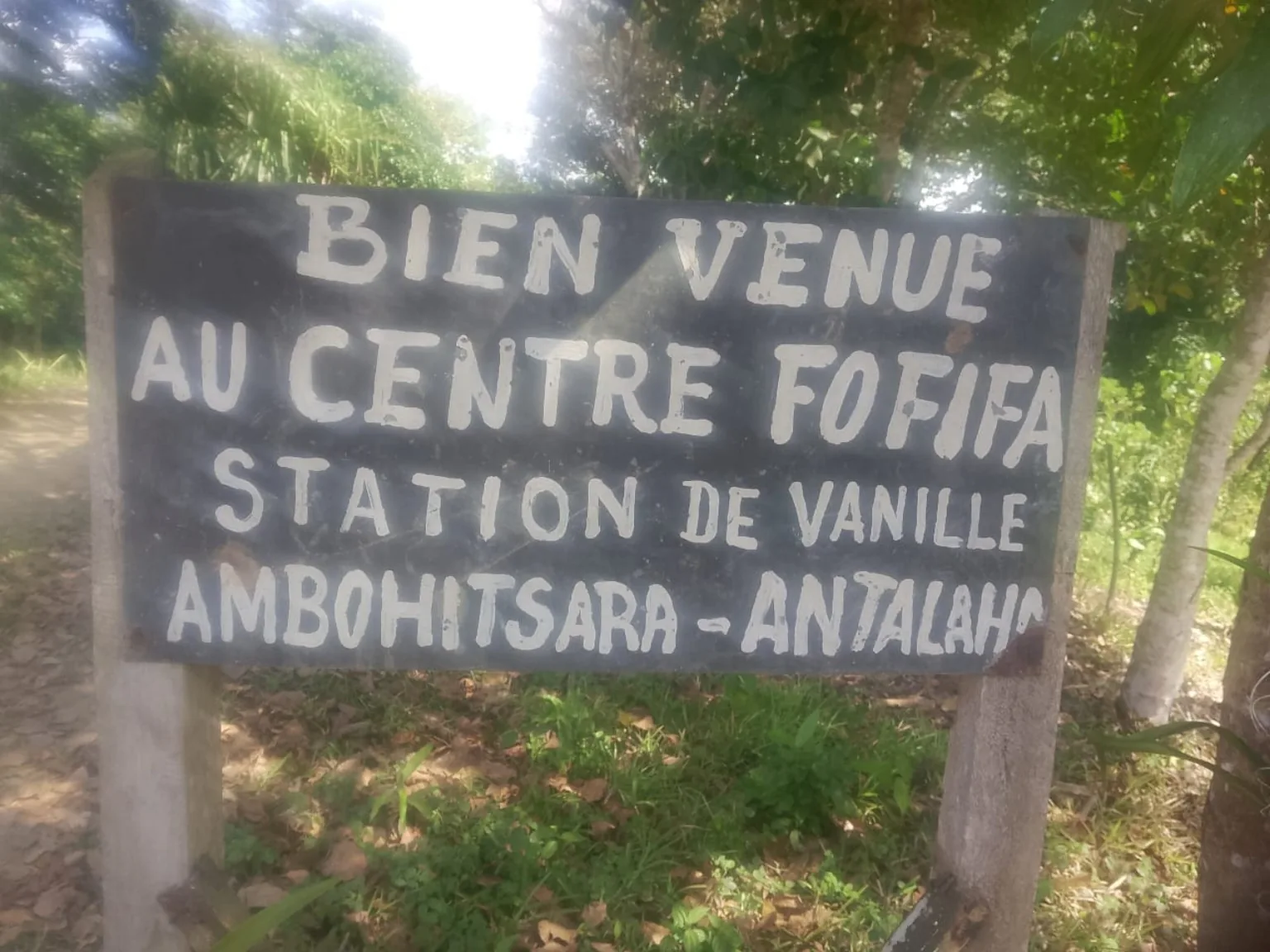
A collection brought from several countries
The first task is to bring in diversity where the region carries a single vanilla. The station gathers 56 cultivars, sent from many countries, from Papua New Guinea to the Americas, spread across several species of the genus Vanilla5. Each arrives as a cutting, takes root on the hills, enters the living collection. They then have to be kept alive together, year after year, which already occupies a whole team.
The vanilla of Polynesia brings its floral and anise-led frame, a pod that stays closed at maturity, a vine with a different conduct. The pompona of the Americas brings thickness: broad stem, fleshy pod, an aromatic register running from flower to fruit, from spice to coumarin, as far as black olive depending on origin. A local species of Madagascar enters as well, taken from those that grow of their own accord on the island and which the wild vanillas of Madagascar describe. Other species of the genus join the collection with successive consignments, each with its own characters.
These species have always lived in contact with the fungi of the soil. It is that habituation the station comes looking for, along with the stem vigour and root robustness that come with it3. Each also brings its aroma, which will become the difficulty of the programme.
Crossing two species of the same genus calls for luck as much as for method. Fertilisations take poorly, pods abort during maturation, seeds germinate sparingly. Each combination retained therefore represents a great many attempts, of which the station's notebooks kept the count.
A share of these cultivars crosses the programme intact. Brought from far away, they remain as they are in the collection, tended for themselves. They form today the other half of what the station conserves, alongside the hybrids it created.
Cross, sow, wait
The vanilla flower opens one morning and closes again by evening. It carries the anther and the stigma in the same column, separated by a fine membrane, the rostellum. That membrane holds the flower apart from itself. It is the membrane the hand lifts at pollination. The gesture is made with a thorn on our plots as in the collections of the station.
Crossing two vanillas adds a step to that gesture. The anther of the mother flower has to be removed before it touches its own stigma, the pollen fetched from the father plant, carried, applied. All of it within the few hours the flower stays open, flower by flower, on vines that bloom in staggered clusters. A season of crosses is counted in mornings.
Then comes the sowing. The vanilla seed is that of an orchid: a black dust, thousands of grains in one pod, each one lacking the reserves that feed an ordinary seed. In nature, a soil fungus brings it what it lacks. In the laboratory, a nutrient medium has to be composed for it and germination carried out under shelter. It is patient work to obtain a few seedlings from one cross.
Then comes the wait. The seedling becomes a vine, the vine climbs, it flowers after 3 to 4 years. The first harvest comes from the fifth year onward. A full preparation must then follow, scalding, sweating, drying, ageing, before knowing what the pod carries on the palate. Each generation of selection costs several years in this way. A vanilla programme is run on the scale of a working life.
Coming back toward the aroma
The first cross gives a robust vine with an aromatic profile far from the one the region prepared. The notes of the wild species dominate, the richness of cultivated vanilla dilutes. The material holds in the field, the pod speaks another language.
The rest of the work consists of coming back. The descendants are crossed again with cultivated vanilla, the plants that still hold are kept, the operation starts over at the next generation. From backcross to backcross, the share of the wild species reduces, the original aroma rises again, the resistance remains among the plants retained. Some crosses set out from hybrids already obtained, which adds another storey to the genealogy1.
Each round costs the time a vine takes to become adult. A line retained therefore crosses several teams. The researcher who judges a progeny works on crosses decided by a predecessor.
Tens of thousands of genotypes come out of this work over the decades1. A handful clears every stage: holding in the field, producing regularly, giving a pod that prepares well and that speaks.
What the fire carried off
A fire, a few years ago, destroyed the majority of the station's archives. The crossing notebooks, the plot records, the genealogies kept by hand for 50 years went with them.
What remains is held in the scattered publications of the period, in the vines still in the ground, in the memory of the people of the station. That is also why this history is told so little.
What still grows
The programme retains 34 hybridisations, of which 23 remain in cultivation today5. The most recent publication devoted to this work, signed by the CIRAD in 2021, counts 19 of them conserved at the station1. We give here the figures as they were communicated to us on site.
Two names circulate more than the others. Tsy taitra carries a Malagasy name that says the unshakeable. The station retains the first selection under that name for its bearing against Fusarium wilt, with an aroma that stayed close to the one the region has always prepared1. Manitra ampotony, the fragrant one, is retained for its aromatic richness, which the same publication places far above a common vanilla1.
Several of these hybrids carry notes that belong to the register of perfumery. They were kept for that. The Ambohitsara collection thus opens several directions at once, one toward the table, another toward the flacon, each holding its place in what has been conserved.
The name Tsy taitra has since covered several crosses. The first, the one the publication describes, joins cultivated vanilla to pompona. Other hybridisations follow under the same name, built on other varieties, cultivated vanilla with the vanilla of Polynesia, pompona with the vanilla of Polynesia, among further combinations. Each carries its own aroma, at times very far from the first. The published literature describes one line, the plots carry several. Manitra ampotony, for its part, comes from a cross between cultivated vanilla and the vanilla of Polynesia, from which it takes a pod that stays closed at maturity. It then ripens on the vine.
These 23 vines form a reserve today. They carry combinations the programme took 50 years to compose, kept alive on a few hectares of hills. Each remains available for what follows, as the parent of a cross to come or as material to distribute when a soil of the region calls for it. A living collection keeps its value as long as the hand that tends it carries on.
What the grower receives
The station distributes cuttings across the SAVA to give growers plants that better resist the soil. A cutting travels well: a few nodes, a little moisture, it takes hold wherever it is laid. What leaves Ambohitsara enters the plantations of the region in this way, is taken as cuttings in turn, passes from one grower to a neighbour.
These vines mingle with the older plots. One same square then carries plants from the historic stock of the region and plants issued from the station, raised on the same supports, conducted by the same hand. The grower tells them apart by the vine and by the leaf. The sizes say which is which. The judgement is then made over time. A new plant shows itself across several seasons: the taking, the first flowering around the fourth year, the bearing of the harvest afterwards, the behaviour of the soil around it. A vine is adopted after being seen through a difficult year. The vanilla growing around Antalaha today carries this history in its rows. We cultivate several of these hybrids.
From cultivar to pod
These names appear now at the point of sale. A buyer who meets them looks to know what they carry in the pod. One same name already covers several in the field.
The cultivar gives the vigour of the vine, its bearing in the field, a share of its aromatic potential. The plot that carried the pod, the moment of harvest, the preparation and the length of the ageing in rosewood trunks give the rest. One same vine planted on two terroirs delivers two vanillas. We know it because we planted them.
A lot is therefore read by what it carries on the palate, once all these hands have passed over it. That is how the ANTOKALY names set out each terroir, profile by profile. The choice is then built with the chef, from the result being sought.
What the island received
The diversity growing in the SAVA came by 2 paths. Ambohitsara opens the first, half a century of patient research to hold a crop upright. The second passes through private hands. In the 1970s, the uncle of one of us brought back cuttings from Polynesia and planted them here. Other enthusiasts did the same, before him as after him. Their vines are still taken as cuttings.
These cuttings take root on family plots, multiply from one place to the next, reach the neighbour who asks for more. Their origin fades with the years. The vine remains.
Madagascar carries in this way a richness in cultivars that few origins gather on a single territory. That richness remains a potential for as long as a hand conducts it. Growing, preparation and ageing lead it from the vine to the aroma. From that work comes the palette a single island offers the world.
The aromatic registers these species open are read in Planifolia, Tahitensis, Pompona. The territory that receives them is read in what the SAVA changes. Madagascar carries terroirs the world is only beginning to discover. We open them lot after lot.
To understand the rest of the journey, discover our savoir-faire, explore our varieties and terroirs, or let us talk through your project.
Professional reference
Connect the reference to the actual material: touch, scent, infusion and intended use together form a complete reading.
Frequently asked questions
What is the Ambohitsara vanilla station near Antalaha?
A vanilla research station on the hills of Ambohitsara, a few kilometres from Antalaha, in the SAVA region. Trials begin there in 1944 to answer Fusarium wilt, the station is founded in 1952, it passes to the IRAT then to the FOFIFA, the Malagasy national centre for applied research on rural development. It remains in activity today.
What is Tsy taitra?
A set of hybrids distributed under one same name, issued from the crossing programme of Ambohitsara. The Malagasy name says the unshakeable. The first selection joins cultivated vanilla to pompona, retained for its bearing against Fusarium wilt with an aroma that stayed close to the one the region has always prepared. Other hybridisations follow under the same name, built on other varieties, each carrying its own aroma. The station distributes them as cuttings to the growers of the SAVA.
What is Manitra ampotony?
Another hybrid born at the Ambohitsara station. Its Malagasy name says the fragrant one. The CIRAD publication devoted to this programme places its aromatic richness far above a common vanilla.
Does a hybrid vanilla give a different aroma?
The cultivar gives the vigour of the vine, its bearing in the field and a share of its aromatic potential. The plot that carried the pod, the moment of harvest, the preparation and the length of the ageing give the rest. One same vine planted on two terroirs delivers two vanillas, which leads ANTOKALY to describe its lots by their profile on the palate.
Sources
- Grisoni M. & Nany F. (2021). The beautiful hills: half a century of vanilla (Vanilla planifolia Jacks. ex Andrews) breeding in Madagascar, Genetic Resources and Crop Evolution. doi.org
- Dequaire J. (1976). L'amélioration du vanillier à Madagascar, Journal d'agriculture tropicale et de botanique appliquée, 23(7-12), p. 139-158. doi.org
- Bory S., Grisoni M., Duval M.-F. & Besse P. (2008). Biodiversity and preservation of vanilla: present state of knowledge, Genetic Resources and Crop Evolution, 55(4), p. 551-571.
- Bouriquet G. (1954). Le Vanillier et la Vanille dans le monde, Paul Lechevalier, Paris.
- Ambohitsara vanilla station, FOFIFA centre, Antalaha. Elements gathered on site.