Bourbon has grown vanilla as an ornamental since 1822. In June 1839, an envoy of the ministry brings the island's planters the news that a vanilla flower can be fertilised by hand. Two or three seasons later, in a garden at Sainte-Suzanne, an enslaved teenager finds the form of the gesture that holds across a whole plantation. He is then sent to teach it from estate to estate. The port registers stay empty until 1846, when they record 36 kg. In 1858, the island ships more than 3 tonnes.
A vine grown as an ornamental
The cuttings reach Bourbon through Marchant, the island's administrator, who obtains them from Bosc in Paris and has them planted on his mother-in-law's estate at la Belle-Eau. The plants that Ferréol Bellier-Beaumont grows at Bellevue, Sainte-Suzanne, descend from these in all likelihood1. The date of that introduction carries a nuance of its own, which the article on the origin of vanilla sets out.
The vine takes hold, it climbs the trunks, it opens its flowers every season. The fruits remain accidents. Far from the Gulf of Mexico, the flower opens in the morning before a garden empty of the insects that know how to cross its membrane. It drops away by evening. The island keeps an ornamental orchid.
The Saint-Denis paper still says so in August 1843: the vanilla vine has been grown at Bourbon for more than 25 years, it flowers abundantly there, it has fruited very rarely and very little8.
Liège, 16 February 1836
Charles Morren holds the chair of botany at the University of Liège and has directed its Botanical Garden since 1835. On that day, he fertilises by hand the flowers of a greenhouse vanilla. It is the first artificial fertilisation of a vanilla flower of which the written record survives1. He obtains 54 pods. The first ripens in February 1837. A second plant gives him 100.
His procedure, he writes it himself: upon lifting or removing the apron, the whole pollen mass, or a part of it, is brought into contact with the stigma. Many flowers can be fertilised in this way2. The movement we know is there, whole, from the first page.
In May 1837, the King of Prussia accepts a sample of these pods1.
The knowledge travels fast
Between 1837 and 1839, the agricultural and botanical journals carry the Liège result across the continent. Joseph Neumann, head gardener at the Jardin du roi in Paris, is the first to succeed with this method. He publishes in 18384. In July of the same year, Poiteau sums up the situation before the Royal Horticultural Society of Paris: vanilla fruited for the first time in Europe in 1836, in one of the greenhouses of the botanical garden of Liège, then in 1838 in one of the greenhouses of the Jardin des Plantes5.
Morren corresponds with Brongniart, de Mirbel, de Jussieu, Gaudichaud-Beaupré, Lindley and Hooker. The network linking Liège, Paris and the colonial gardens already exists.
16 June 1839, Perrottet lands
Georges Guerrard-Samuel Perrottet is an agricultural botanist in the service of the French government. His mission is to carry crops and techniques from one end of the colonies to the other. He arrives at Bourbon on 16 June 1839 and spends 4 months visiting the island's estates1.
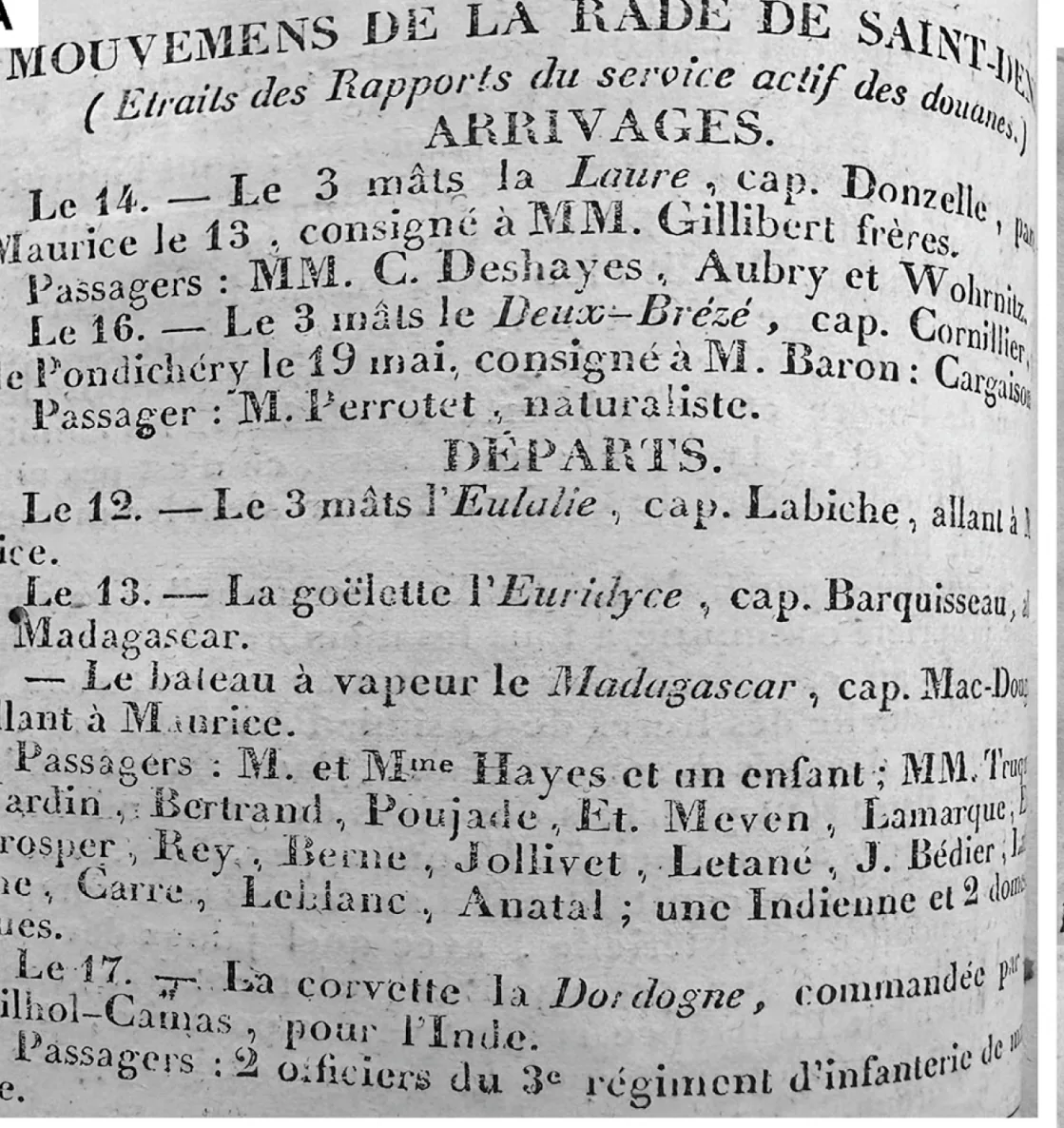
Twenty years later, in a letter of 30 April 1860 published in the Moniteur officiel of Pondicherry, he recounts what he said there.
As for the fertilization of vanilla, I had spoken about it to several people on my last trip to the colony towards the end of 1839, in particular to MM. Patu de Rosemond, Bellier-Beaumont, Lépervanche, Mézière, distinguished botanist. I indicated to them the method followed by Mr. Neumann.
The three men he names are among those who raise Edmond and start him in botany. Perrottet adds a sentence that the rest of this history makes decisive.
The method is simple and within everyone's reach. But it was necessary to put it into practice, and the one who first operated it on a large scale must have the merit, if not of its discovery, at least of its practical use.
The method reaches Bourbon a second time, by another road. In July 1842, the island's Comité d'Agriculture announces that it has received the memoir of Pierre-Sébastien Dupuy, first-class naval pharmacist in Guadeloupe. The report says that this memoir contains the indication of a newly discovered process, by means of which France and the Antilles have made productive this plant which had until then remained sterile, as it had at Bourbon7.
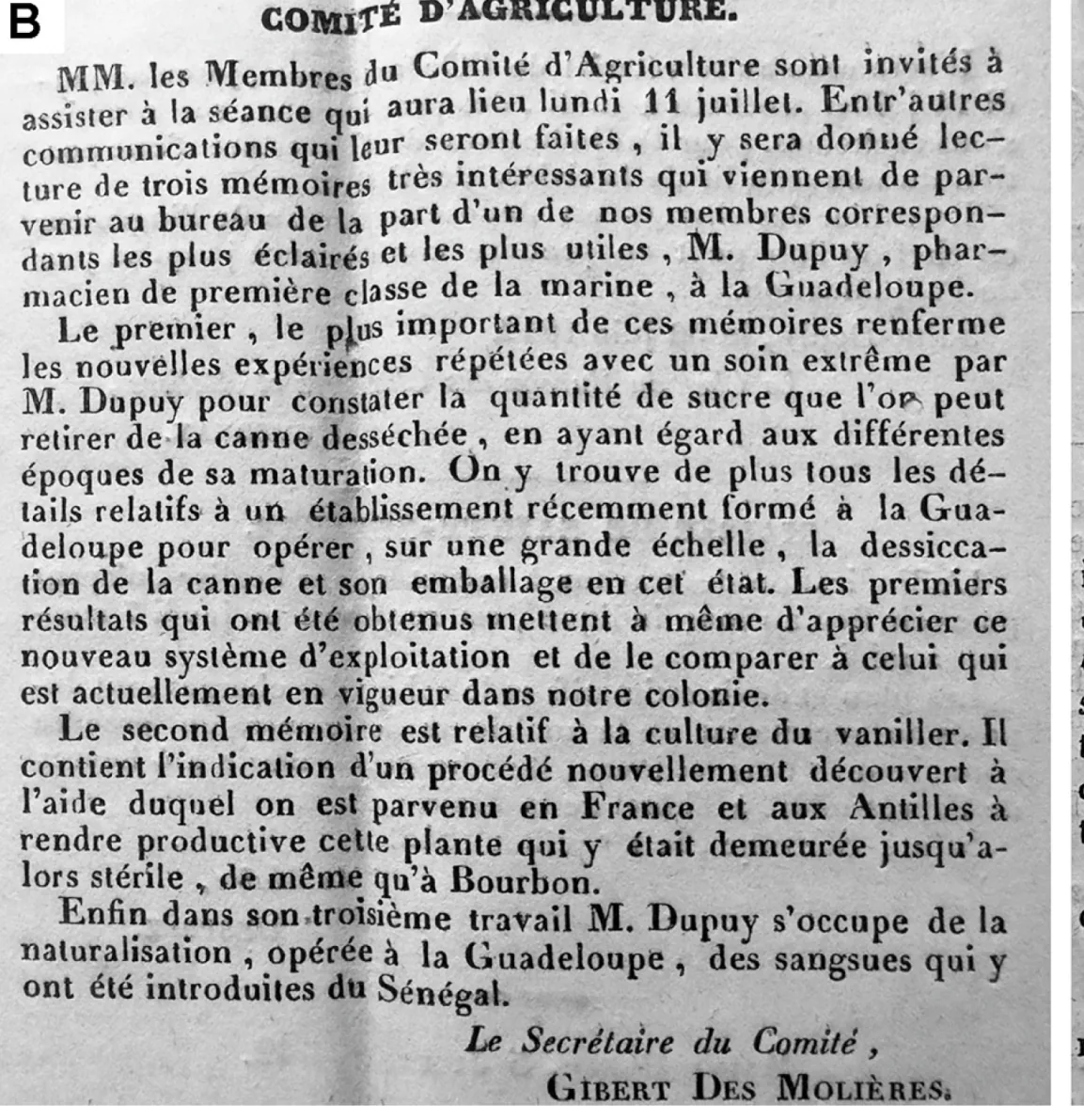
A simple reference
The principle circulates on the island before Edmond. What is still missing lies in the practice: a form of the gesture that hundreds of hands take up on the same morning.
The garden of Bellier-Beaumont
Edmond is born in 1829. His mother dies giving birth to him. She was a slave of Madame de Bellier-Beaumont. The child passes to her brother, Ferréol, a landowner at Sainte-Suzanne on the east coast of the island, who makes him his favourite1.
He grows up in the garden. School stays closed to him, botany occupies him. He studies and experiments on cultivated plants alongside Mézières Lépervanche, a nephew of Ferréol raised by his uncle. Lépervanche is the trained botanist of the household, a correspondent of several members of the Academy of Sciences. Both men start Edmond in botanical study and instruct him on fertilising vanilla flowers1.
The knowledge of Liège therefore reaches this garden, carried by the men who teach a child of 10 there.
The gesture
A finely cut sliver of bamboo lifts the membrane. The thumb brings the anther against the stigma. The flower closes on a pod. A few seconds are enough.
The tool fits in the palm. The form is learned in a morning, it is repeated hundreds of times before noon, it calls for a practised hand. Lépervanche will say it in the terms of his day: the procedure that came from Europe was much less simple10.
On 30 August 1843, the description appears
The first public description of the practical process appears in the Feuille Hebdomadaire of Saint-Denis, under the title « Fécondation artificielle des fleurs de vanillier-aromatique », signed with the initials L. P. The text announces that fertilisation succeeds perfectly by a process of the simplest kind. It gives the result obtained on one estate of the island: a vanilla stem less than 3 feet long carries 30 fruits, another stem that had flowered less carries 5 or 68.
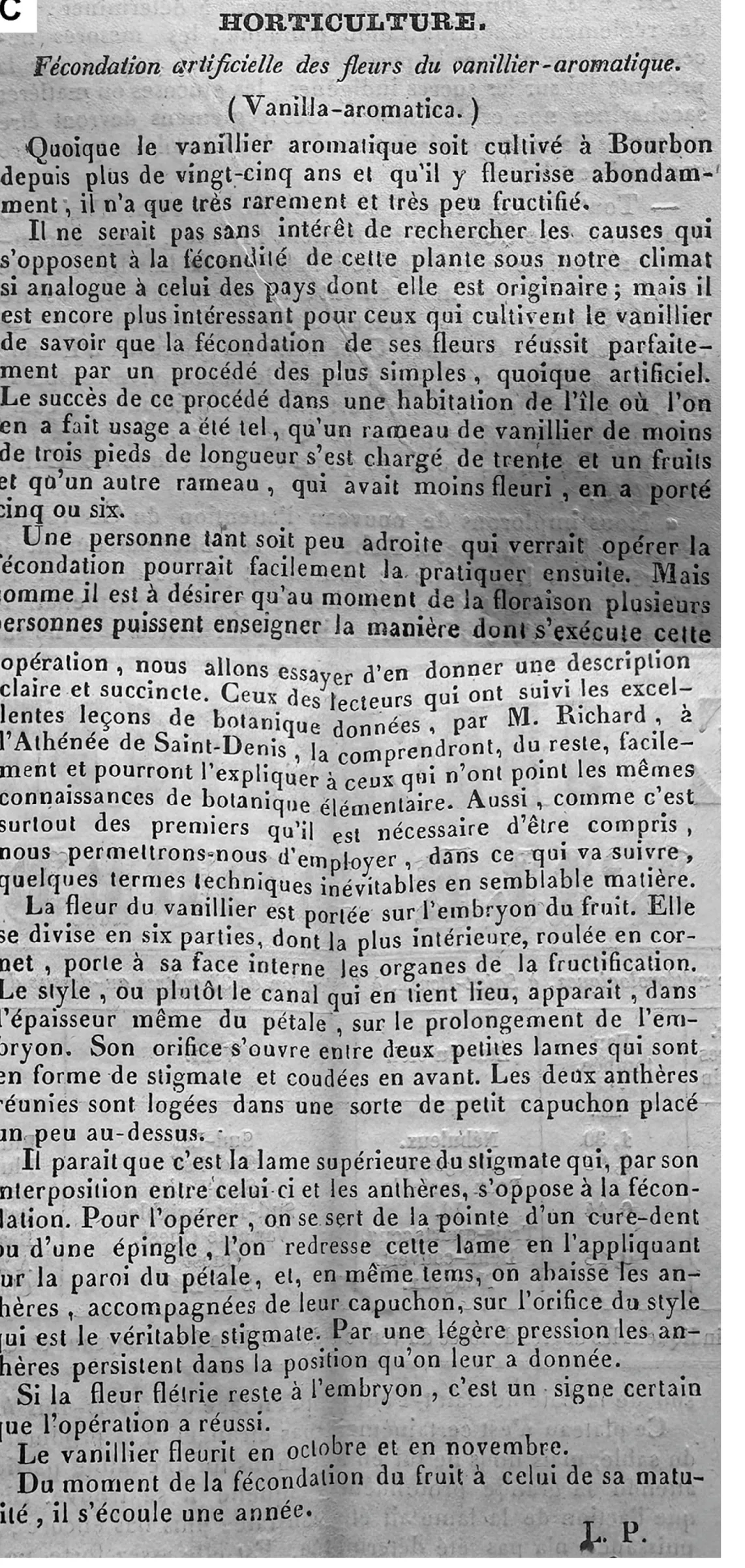
Then comes the working method, written for readers holding a flower for the first time.
To operate, one uses the point of a toothpick or a pin, one raises this blade by applying it against the wall of the petal, and, at the same time, one lowers the anthers, together with their hood, onto the orifice of the style which is the true stigma. Under a light pressure the anthers hold the position they have been given.
The article adds a sentence that decides what follows: it is to be wished that at the time of flowering, several people should be able to teach the manner in which this operation is carried out8. The question put to the island lies in that verb, to teach.
What is asked of him next
The document that founds Edmond's merit is a letter from Mézières Lépervanche to the governor, dated 8 December 1853. It records a precise fact: Edmond is sent to the estates of Mr Patu de Rosemond, Mr Floris, Mr Desbassayns and Mr Vinet, to pass on the gesture of fertilisation with his own hand10.
A teenager goes from estate to estate teaching the island's planters how to hold a flower. That round makes the crop.
His documented contribution holds in 2 stages. Having given hand fertilisation a simple form, workable at the scale of a plantation and reproducible by any trained hand. Having passed the gesture on afterwards, estate after estate. Artificial fertilisation existed in the glasshouses of Europe. The gesture that holds within a working day comes from that garden at Sainte-Suzanne.
The same letter sets a limit that later accounts will erase. Lépervanche writes that fertilisation had already been practised 10 years earlier in an orangery in Brussels, as well as at the Natural History Museum in Paris. He adds that this discovery had its echo in the learned world alone10. The man who defends Edmond before the governor names Liège and Paris himself.
The port registers
The island's figures accompany that round. The export registers stay empty until 1846, when they carry 36 kg. They record 267 kg in 1853, then more than 3 tonnes in 18581. These figures give the curve of the rise, not the account of its causes. Planted area, market prices and the organisation of the estates all work at it alongside the gesture. What the gesture brings is the condition without which none of that produces a pod. The island soon becomes the world's leading exporter. The Indian Ocean has held that rank ever since.
Around 1841, the date tradition holds
The year 1841 accompanies this scene everywhere. It comes from a late text, Volsy Focard's article of 10 October 1862, the first printed record linking the name of Edmond Albius to the fertilisation of vanilla9. Focard writes from an exchange of letters with Patu de Rosemond, Bellier-Beaumont and Lépervanche.
Yet Bellier-Beaumont, asked on 17 February 1861, answers this.
Although I have before me the draft of the note that, in time, I sent to the editor of the country's first newspaper, Mr. de Montmerqué, having neglected to date it, I cannot tell you very precisely the year of the discovery. My memories and those of the young black man, author of the discovery, point us to 1841.
The review published in 2024 by the botanist Adam Karremans notes that Montmerqué lands at Bourbon on 12 September 1842 and takes over the editorship of the Feuille Hebdomadaire in early 18431. Bellier-Beaumont's note therefore leaves at the end of 1842 at the earliest. A letter of 1 November 1841 published in the same paper, signed L. B., calls on the Comité d'Agriculture to promote vanilla growing and stays silent on what is happening at the Bellier-Beaumont estate3. Karremans places Edmond's trials between 1840 and 1842, on two accounts that admit their own uncertainty.
The year keeps its approximation. The gesture holds its date: on 30 August 1843, it is in print.
The merit disputed
His merit is contested in his lifetime. Bellier-Beaumont takes up his pen on 9 December 1862 to return it to him. His letter says both things at once.
In 1837, we had already managed to make the Vanilla planifolia bear fruit by a process different from that of Edmond. We cut the labellum that forms an operculum with the stigmatic surface. Mr. Richard, at the Paris Plant Garden, must naturally have been informed of the discovery made in Liège. Before Edmond, no one, even Mr. Richard, had practised fertilization in Bourbon.
The Mr Richard named here is Jean Michel Claude Richard, director of the island's botanical garden, a member of the Comité d'Agriculture, a close friend of Perrottet1. The article of 30 August 1843 already cites him, referring its readers to the excellent botany lessons given by Mr Richard at the Athénée of Saint-Denis8. The scholar and the teenager stand on the same newspaper page, each in his place.
1848
The abolition of slavery in the French colonies frees him in 1848. He then takes the name Albius, leaves the Bellier-Beaumont estate and leaves vanilla behind him1.
He dies in 1880, poor.
The process he taught from estate to estate carries an industry by then. Every town on Réunion has its rue Edmond-Albius today, a bronze memorial has stood at Le Bocage in Sainte-Suzanne since 10 May 2004. His portrait hangs wherever vanilla is grown, prepared or sold1.
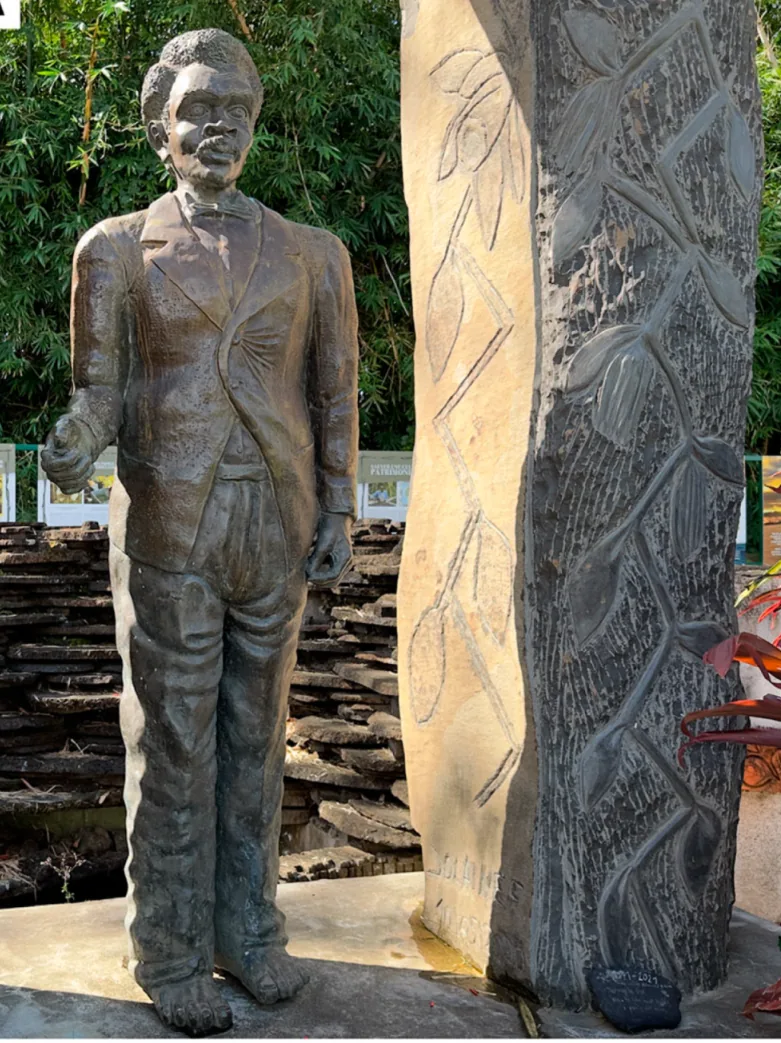
What the hand opened
The cuttings that reach Nosy Be in 1870, then the SAVA, leave from this island where the gesture has just become a practice. The vanilla we prepare in Antalaha descends from that succession of hands.
A century and a half earlier, vanilla already crossed the treatises of the kingdom and was counted in bundles of 50 stems, coming from Mexico stem by stem. Madagascar carries its own wild species. The Bourbon name keeps the name of the island where Edmond taught.
On our plots, the thorn replaces the bamboo and the rest remains. The detail of the gesture is set out in pollinating vanilla by hand. Madagascar carries terroirs the world is only beginning to discover. We open them lot after lot.
To follow the rest of the journey, discover our savoir-faire, explore our varieties and terroirs, or let's talk about your project.
Professional reference
Connect the reference to the actual material: touch, scent, infusion and intended use together form a complete reading.
Frequently asked questions
Who discovered the hand pollination of vanilla?
Charles Morren, a botanist at Liège, is the first of whom a written record survives. He fertilised vanilla flowers by hand on 16 February 1836 and obtained 54 pods. Joseph Neumann succeeded in Paris and published in 1838. Edmond Albius, on the island of Bourbon, worked out the practical form of the gesture and taught it to the island’s planters, which opened commercial cultivation.
What exactly did Edmond Albius invent?
A way of fertilising the flower that holds at the scale of a plantation, with a sliver of bamboo and a press of the thumb, and then its transmission. A letter from Mézières Lépervanche to the governor, dated 8 December 1853, records that Edmond was sent to the estates of Patu de Rosemond, Floris, Desbassayns and Vinet to teach the gesture there.
Does Edmond Albius's discovery really date from 1841?
The year 1841 comes from a text of 1862. Ferréol Bellier-Beaumont, asked in 1861, writes that he cannot say precisely the year of the discovery and that his memories point to 1841. A review published in 2024 by the botanist Adam Karremans places the trials between 1840 and 1842. The first public description of the process appears on 30 August 1843 in the Feuille Hebdomadaire of the island of Bourbon.
What became of Edmond Albius?
The abolition of slavery in the French colonies freed him in 1848. He then took the name Albius and left the Bellier-Beaumont estate. His merit was contested in his lifetime, and Bellier-Beaumont wrote in 1862 to return it to him. He died in 1880, poor. A bronze memorial was raised to him at Le Bocage, Sainte-Suzanne, on 10 May 2004.
Sources
- Karremans A. P. (2024). A Historical Review of the Artificial Pollination of Vanilla planifolia: The Importance of Collaborative Research in a Changing World, Plants, 13(22), 3203. The reproductions from the Feuille Hebdomadaire and the photograph of the memorial are the author's, reused under the CC BY 4.0 licence. doi.org
- Morren C. (1837). Note sur la première fructification du vanillier en Europe, Annales de la Société d'horticulture de Paris, vol. 20, p. 331-334. See also Morren C. (1839). On the Production of Vanilla in Europe, Annals of Natural History, 3, p. 1-9.
- Anonymous [L. B., Saint-Louis, 1 November 1841]. Industrie agricole de la vanille, Feuille Hebdomadaire de l'île Bourbon, no. 1193, p. 3.
- Neumann J. (1838). Vanille, Annales de Flore et de Pomone, 6, p. 316-320. See also Neumann J. (1839). Vanille à feuilles planes, Vanilla planifolia, Horticulteur Universel, 1, p. 169-175.
- Poiteau P. A. (1838). Note sur la Vanille, Annales de la Société d'horticulture de Paris, 130, p. 99-102.
- Perrottet G. S. (1860). Introduction du Vanillier à la Réunion, letter of 30 April 1860, Moniteur officiel of Pondicherry, 4 May 1860.
- Comité d'Agriculture of Bourbon, notice of the session of 11 July 1842, Feuille Hebdomadaire de l'île Bourbon. Memoir of Pierre-Sébastien Dupuy on the cultivation of the vanilla vine.
- Anonymous [L. P.]. Fécondation artificielle des fleurs de vanillier-aromatique, Feuille Hebdomadaire de l'île Bourbon, 30 August 1843, no. 1287, p. 2.
- Focard V. (1862). Introduction et fécondation du vanillier à l'île Bourbon, Bulletin de la Société des sciences et arts de la Réunion, 1, p. 223-235.
- Letter of Mézières Lépervanche to the governor, 8 December 1853, reproduced in Focard (1862) and in full in Chabin (1981).
- Chabin M. (1981). Edmond Albius et la découverte de la fécondation artificielle de la vanille : la correspondance entre Bellier-Beaumont et Volsy-Focard, Archives de Bourbon, 10, p. 465-490.